
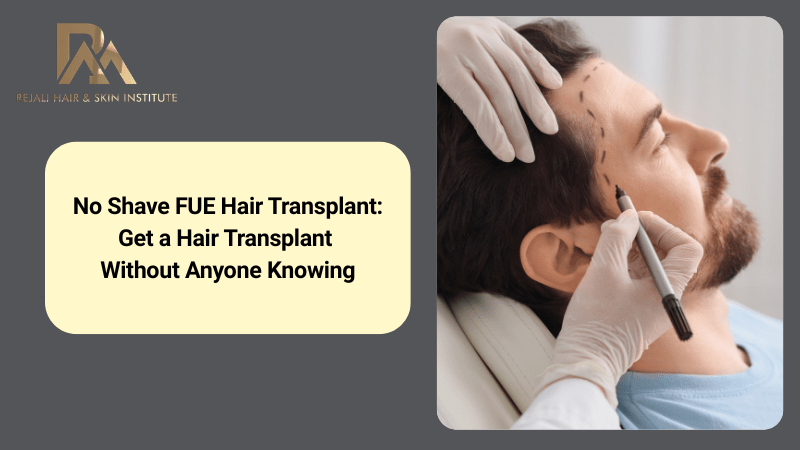
No Shave FUE Hair Transplant: Get a Hair Transplant Without Anyone Knowing
For many people, the biggest worry about hair restoration isn’t the surgery — it’s the visibility of the process. A shaved scalp announces to the world that something happened. A no shave FUE hair transplant solves that problem, letting you walk out of the clinic looking almost exactly as you did walking in, with no bandages, no shaved patches, and no explanations owed to anyone.
What Is a No Shave FUE Hair Transplant?
Follicular unit extraction (FUE) harvests individual hair follicles directly from the donor area — no strip of skin, no linear scar. Traditionally, the donor zone was shaved for speed and visibility. The no-shave adaptation uses modern precision tools that allow the surgeon to work around your existing hair instead. For a deeper look at the technique itself, see our guide to how a long hair FUE hair transplant works.One common myth worth dispelling upfront: no-shave procedures are just as permanent as traditional ones. The biology of graft survival is identical regardless of whether the donor area is shaved. The follicles are equally viable — only the patient experience changes.
How the Procedure Works
Working within a full head of hair demands heightened expertise from the surgical team:
- Layered donor preparation. The surgeon works section by section, trimming only the specific follicles needed for extraction. The surrounding hair stays at its natural length, providing built-in coverage for the small extraction sites.
- Individual graft extraction. Each unit is harvested with specialized micro-punches under high magnification, requiring intense focus to preserve graft integrity while navigating between long strands.
- Artistic implantation. Grafts are placed to follow the natural angle and pattern of your existing hair. At Rejali Medical, Dr. Rejali personally performs the hairline design, extraction, and recipient site creation — using hybrid micro-punch technology rather than automated systems, which rely on larger punches and produce higher transection rates.
Because the surgeon works around long hairs throughout, expect a longer procedure than a standard shaved session.
Why Patients Choose the No-Shave Route
Complete discretion. The signature extraction dots stay hidden beneath your existing hair, so there are zero visible markers of recent surgery.
Immediate return to public life. No waiting weeks for a buzz cut to grow out before you feel comfortable in a boardroom, on camera, or at a social event. This is why professionals and public figures gravitate toward the technique.
Psychological comfort. Patients consistently report a faster emotional rebound when their reflection looks normal from day one. Being able to style your hair as usual lowers stress during the early growth phase — and confidence in the process tends to raise overall satisfaction.
No-Shave FUE vs. Traditional FUE
Both paths deliver the same biological result; the trade-offs are logistical:
| Feature | Traditional FUE | No-Shave FUE |
|---|---|---|
| Donor preparation |
Fully shaved |
Unshaved/limited |
| Surgical duration |
Faster |
Longer |
| Discretion level |
High |
Maximum |
| Technical effort |
Standard |
Advanced |
| Cost |
Standard |
Higher |
Scalp healing behaves the same in both cases — the tiny extraction sites crust over and heal within days to a week. The difference is that with no-shave FUE, nobody sees it happen. The added time and precision do mean a higher investment, which most privacy-focused patients consider well worth it. For a full side-by-side breakdown, read our comparison of long hair FUE vs. shaved FUE.
Are You a Good Candidate?
A no shave FUE hair transplant works best for patients who meet a few criteria:
- Adequate hair length — roughly two inches or more, enough to camouflage the donor area effectively.
- Smaller to mid-sized graft needs — targeted hairline work and focal restoration suit the technique best; very large, multi-session harvests are often better served by standard FUE, which gives the surgeon clearer access.
- A lifestyle that demands discretion — frequent public interaction, client-facing work, or simply a preference to keep your procedure private.
- Good general and scalp health — you should be medically fit for elective surgery, with no active scalp inflammation.
Patients with very fine hair or extremely tight donor density may also be steered toward a traditional approach for the best outcome. And the technique isn’t just for men — long hair FUE is an excellent option for women experiencing diffuse thinning who want to preserve their length.
Recovery and Aftercare
Your head may look normal immediately, but the skin underneath is still healing — treat it that way:
- Manage mild sensitivity in the first 48 hours with cooling techniques or light medication.
- Use only the recommended gentle shampoos during the first week to protect graft stability.
- Avoid vigorous activity, direct sun, and any friction on the grafts.
- Style and brush gently for the first few weeks — no pressure on the transplant sites.
Grafts anchor firmly after about a week. Some shedding follows, which is a normal precursor to the permanent growth cycle. Growth rate is driven entirely by your biology — the no-shave method doesn’t slow it down.
Choosing the Right Surgeon
This technique is a niche skill. Look for a surgeon with documented no-shave experience, manual dexterity in graft harvesting, and a portfolio showing donor areas that match patients’ original density. Board certification matters too — Dr. Rejali is a Diplomate of the American Board of Hair Restoration Surgery with more than 6,000 procedures performed since 2006.
Frequently Asked Questions
How does the surgeon see the follicles without shaving? High-magnification surgical loupes and specialized lighting let the surgeon isolate individual units while leaving surrounding shafts long and undisturbed.
Can I return to work the next day? Most patients return to professional roles within a few days, since the donor area stays hidden — just avoid strenuous activity.
Will the donor area look thin afterward? No. Grafts are harvested unit by unit and spread across the entire donor zone, so the extraction sites are virtually invisible once your hair is brushed back into place.
Is growth slower with the no-shave method? No. Regrowth depends on your biological cycles, which aren’t affected by the extraction method.
Does it cost more than traditional FUE? Yes — the extended time and specialized precision typically mean a higher cost than a standard shaved session.
Who isn’t a good candidate? Patients with very fine hair, limited donor density, or plans for very large harvests may get better results from a standard shaved approach.
Ready to restore your hair without anyone knowing? Schedule a consultation with Dr. Rejali in Scottsdale to find out if a no shave FUE hair transplant is the right fit for your hair and lifestyle.