










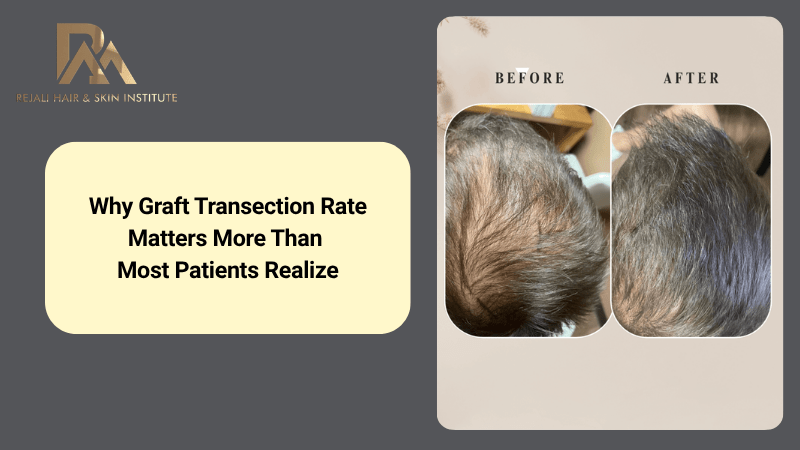
Most people researching hair transplants focus on graft count, technique names, or before-and-after photos. Far fewer ask about WAW FUE transection rate and graft quality — even though this single number has more influence over your final result than almost anything else discussed in a consultation.
What Transection Actually Means
Transection is the accidental cutting or damaging of a hair follicle during extraction. Every follicle is connected to a dermal papilla, the structure that supplies its blood and nutrients — sever that connection, and the graft can no longer grow hair once it’s transplanted. It’s not a cosmetic imperfection you can fix later; a transected graft is simply gone.
This matters because donor hair is a finite, non-renewable resource. Unlike a surgical mistake that heals or a hairline that can be revised, a transected follicle can’t be recovered or reused. Every percentage point of transection represents a real, permanent reduction in how much hair you have available — both for this procedure and for any future one.
Why Transection Rates Vary So Widely
Rates differ dramatically depending on who’s performing the extraction and what tools they’re using. Worldwide averages with lower-quality punches or less experienced technicians can run as high as 20–30%. Clinics that meet a stronger clinical standard typically report rates of 3% or lower, with the most credentialed surgeons commonly achieving under 2%.
A hybrid punch system — like the trumpet-shaped design used in WAW FUE — is built specifically to address this gap. Because it pairs a sharp outer edge with a smooth, curved inner edge, it follows a follicle’s natural angle instead of cutting through it in a straight line, which is where many transections happen. Real-time control over punch speed and rotation lets a surgeon adjust for hair type as extraction moves across the scalp, rather than using one fixed setting for every patient.
What Drives Transection Beyond the Tool Itself
The punch matters, but it isn’t the only variable. Surgeon expertise and technique — specifically, following each follicle’s internal angle rather than a uniform depth — has a direct effect on the outcome. Curved or curly follicles carry inherently higher risk regardless of tool quality, which is why some clinics perform small test extractions before committing to a full donor-area harvest. Who performs the extraction matters too: rates tend to be markedly better when a trained surgeon does the work directly rather than delegating it to less experienced staff, a distinction our page on why FUE needs to be done only by certified doctors explains in more detail.
How This Affects the Grafts You Actually Receive
A lower transection rate doesn’t just mean fewer wasted follicles — it changes the quality of what’s transplanted. Grafts extracted with less trauma tend to retain more of their surrounding protective tissue, which is associated with more reliable regrowth after placement. That’s part of why the difference between a 5% and a 25% transection rate isn’t a rounding error; it can mean the difference between needing one session and needing two, or between a donor area that still has options later and one that doesn’t. For more on how graft handling after extraction affects the final result, see our page on FUE graft survival.
Key Takeaways
- Transection is permanent follicle damage during extraction — a transected graft cannot grow hair after transplant.
- Rates commonly range from under 2% at top clinics to 20–30% worldwide on average.
- Hybrid punch systems like WAW FUE are designed to follow each follicle’s natural curve, reducing transection risk.
- Surgeon skill and who actually performs the extraction matter as much as the tool itself.
FAQ
What is considered a good transection rate? Most clinical standards consider 3% or lower to be good to excellent, with sub-2% viewed as an elite benchmark.
Can transection rate be checked before choosing a clinic? Ask directly — a transparent clinic should be able to share its typical transection rate and explain what steps it takes to keep it low.
Does hair type affect transection risk? Yes. Curly or tightly coiled follicles curve more beneath the scalp and are inherently harder to extract without damage, regardless of the tool used.
If you’d like a clearer picture of what transection rate and graft quality would look like for your own hair, you can request a free consultation with Dr. Rejali Hair & Skin Institute in Scottsdale.