










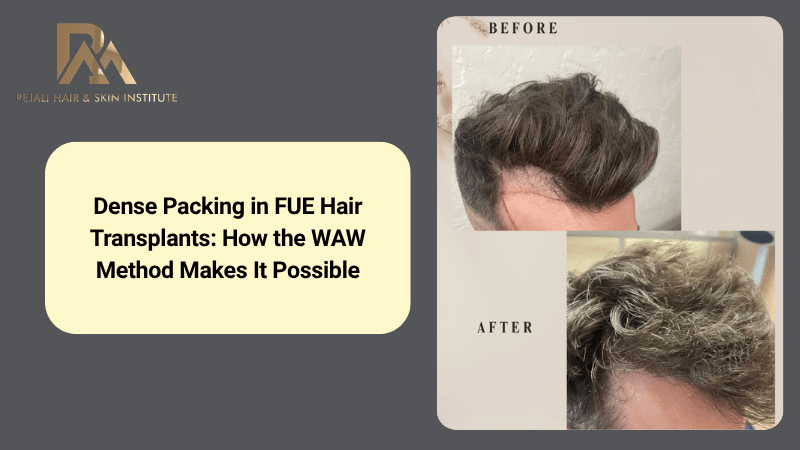
If you’ve compared before-and-after photos from different clinics, you’ve probably noticed some results look noticeably fuller than others, even with a similar graft count. Much of that difference comes down to density — and specifically, to WAW FUE dense packing hair transplant technique, which allows more grafts to be placed safely into a given area without compromising blood supply or graft survival.
What “Dense Packing” Actually Means
Dense packing refers to placing a higher concentration of grafts into a defined zone — commonly the area just behind the hairline, where visual impact matters most. Surgical literature on focal dense-packing describes achieving roughly 40–60 follicular units per square centimeter within a localized zone of about 2.5–3 cm², using primarily two-hair grafts placed methodically until the area is filled in. The goal isn’t maximum density everywhere; it’s concentrated density exactly where it creates the strongest visual improvement.
For comparison, our own guide on what density looks like for FUE breaks down how a conservative 35 FU/cm² differs from a balanced 45 FU/cm², and why 55+ FU/cm² is reserved for select cases with strong donor supply.
Why Density Has a Ceiling
Packing grafts too closely isn’t automatically better — placing follicular units too near one another can compromise blood supply to the recipient sites, which lowers graft survival rather than improving it. That’s the tension every dense-packing plan has to manage: enough density to look convincingly full, without exceeding what the scalp’s blood supply can actually support.
This is where extraction technique becomes relevant to density, even though the two might sound like separate topics. A hybrid punch system, like the trumpet-shaped design used in WAW FUE, is associated with meaningfully lower transection rates — often under 4%, compared to a 20–30% worldwide average with lower-quality tools. Grafts extracted with less trauma tend to be more intact and more resilient, which means more of them survive being packed closely together during placement. In effect, better extraction is part of what makes safer, higher-density packing possible in the first place.
How Many Grafts Actually Fit in a Session
Density planning also has to work within the reality of how many grafts a single session can safely include. Our page on how many grafts fit in one FUE session walks through how session size, area, and density target all interact — a useful companion to this discussion, since dense packing in one zone often means a more conservative density elsewhere to stay within safe overall limits.
What Dense Packing Means for Your Result
For patients with early-stage recession or a hairline that needs meaningful visual impact, dense packing behind the frontal edge can create a stronger sense of fullness than spreading the same number of grafts evenly across a larger area. It’s also frequently used for cowlick zones, for female patients concerned about scalp visibility, and to reinforce sparser areas during a follow-up procedure. The tradeoff is that concentrating grafts in one area means less density is available elsewhere, so the decision belongs in a broader conversation about your whole scalp and donor supply — not just the zone that concerns you most today.
Key Takeaways
- Dense packing concentrates grafts (commonly 30–50+ FU/cm²) in a specific high-impact zone, usually just behind the hairline.
- Density has a practical ceiling — too many grafts too close together can compromise blood supply and reduce survival.
- A hybrid extraction punch that lowers transection rate helps make safer dense packing possible by producing more resilient grafts.
- Dense packing in one zone typically trades off against density elsewhere, so it should be planned as part of your full treatment map.
FAQ
Is dense packing safe for every patient? It depends on donor supply, scalp blood flow, and the specific zone being treated — a surgeon needs to assess your case directly rather than apply one standard density to everyone.
Does dense packing use more grafts overall? Not necessarily more total grafts, but it does concentrate more of them into a smaller area, which usually means less density elsewhere in the same session.
How long before dense-packed grafts show results? Like any transplanted hair, growth develops gradually over several months, with a fuller, more settled appearance typically visible closer to the one-year mark.
To see whether dense packing makes sense for your hairline, schedule a free consultation with Dr. Rejali Hair & Skin Institute in Scottsdale.