










Why Is Crown Hair Restoration Different From Hairline Restoration?
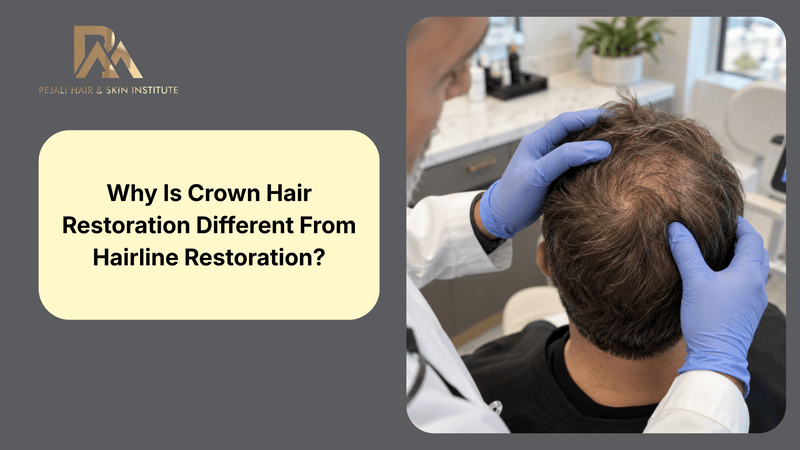
The crown and vertex follow a natural whorl pattern, with hair radiating outward from a central point in multiple directions at once. A hairline, by comparison, generally grows forward in a fairly consistent line.
That single difference changes almost everything about how a transplant in this area needs to be planned.
Crown thinning can also involve a larger surface area than most people expect, since it often extends outward gradually before it becomes noticeable in a mirror. Because of that spiral growth pattern, density here has to blend into the surrounding hair rather than form one uniform patch of coverage.
Visual fullness in the crown depends less on raw graft count and more on getting direction and distribution right. Two patients with a similar number of grafts can have very different-looking results depending on how closely the transplanted hair follows the scalp’s existing rotational pattern.
How Non-Shaven FUE Is Used for a Crown Hair Transplant
During non-shaven FUE, healthy donor follicles are extracted individually from the donor area, and the hair surrounding the treatment site is preserved rather than trimmed down. That preserved hair can help the treated area stay less noticeable while grafts heal and settle in.
Grafts are then placed to follow the patient’s own crown pattern rather than a generic template, since the whorl’s direction varies somewhat from person to person. This individualized mapping is part of what makes crown work more technically demanding than a straightforward hairline case.
Whether non-shaven FUE is the right fit for a particular crown depends on several factors working together:
- The size of the thinning area and how far it extends from the central whorl
- Donor hair availability relative to what the crown will require
- Existing density in and around the vertex
- The total number of grafts needed to achieve natural-looking coverage
A consultation is typically where these factors get evaluated together, since crown planning rarely comes down to just one variable.
Getting Graft Angle, Direction, and Density Right
Because the crown grows in a spiral rather than a straight line, graft angle and direction matter more here than almost anywhere else on the scalp.
Hair that is technically healthy and growing well can still look unnatural if it was placed at the wrong angle relative to the surrounding whorl.
Even small adjustments in direction can change how effectively a graft contributes to visible coverage, which is why this planning tends to take more time and attention in the crown than in other areas.
Density planning adds another layer of complexity. Crown thinning can cover a fairly wide surface area, and trying to maximize density everywhere at once can use up a significant share of available donor hair.
Donor supply is finite, and grafts used in the crown are grafts that will not be available if frontal or mid-scalp thinning develops later.
For that reason, crown restoration usually calls for long-term thinking rather than pursuing the highest possible graft count in a single session. A plan that accounts for how hair loss may progress over time tends to hold up better than one built around maximizing today’s results alone.
Who May Be a Good Candidate for Non-Shaven FUE Crown Restoration?
Not every case of crown thinning is approached the same way, and candidacy depends on a combination of factors rather than any single one, alongside the broader hair restoration options available for different patterns of loss. Good candidates for non-shaven FUE in the crown typically have:
- Stable or slowly progressing crown thinning, rather than sudden or unpredictable loss
- Adequate donor hair available to support the treatment area
- A clearly defined pattern of crown or vertex thinning
- A healthy scalp with no active conditions that would affect healing
- Realistic expectations about how much density and coverage are achievable
Ongoing diffuse thinning, or hair loss that is progressing quickly across the scalp, may need to be evaluated and, in some cases, stabilized before surgical planning makes sense.
What Results Can You Expect After a Crown Hair Transplant?
Early healing typically includes some temporary shedding of the transplanted hairs, which can feel discouraging but is a normal part of the process rather than a sign that the transplant did not take. New growth develops gradually from there, not all at once.
Because the crown covers a wider area and grows in a more complex pattern than the hairline, visible results here often take longer to fill in fully. Patience matters more in this area than almost anywhere else on the scalp.
Final appearance depends on several factors working together, including how well the grafts survive, natural hair caliber and curl or texture, donor density, and how the transplanted hair blends with the hair that was already there.
Reviewing real non-shaven FUE before-and-after results can also help set realistic expectations for how a crown case typically progresses.
Moving Forward With a Crown-Specific Plan
The crown isn’t treated like a frontal hairline. Results that look natural depend on careful whorl reconstruction, realistic density planning, and donor hair that’s managed with the long term in mind rather than spent all at once.
Dr. Rejali Hair & Skin Institute builds each non-shaven FUE plan around your own growth pattern rather than a one-size-fits-all template.
If crown or vertex thinning has you weighing treatment options, scheduling a free consultation is the most direct way to find out whether non-shaven FUE fits your situation.
Frequently Asked Questions
-
Is non-shaven FUE effective for crown hair loss?
It can be, for patients with a well-defined thinning pattern and enough donor hair to support the treatment area. Effectiveness depends on matching graft placement to the crown’s whorl pattern and setting realistic goals for density, which is why individual evaluation matters more here than in most other areas.
-
How many grafts are typically needed for a crown hair transplant?
There’s no single number that applies to every patient, since graft counts depend on the size of the thinning area, existing density, and how much donor hair is available without compromising future coverage needs. This is usually determined during a consultation rather than estimated in advance.
-
Why does a crown hair transplant require different graft placement?
Because hair at the crown grows in a circular whorl instead of one consistent direction, grafts have to be angled to follow that spiral pattern. Placement that works well on a hairline can look unnatural in the crown even when the hair itself is healthy.
-
How long does it take to see crown hair transplant results?
Early shedding is normal in the first few weeks, followed by gradual new growth over several months. Because the crown covers a wider, more complex area than the hairline, full results tend to take longer to become visible compared to frontal restoration.
-
Can the crown continue thinning after a hair transplant?
Yes, surrounding native hair can continue to change over time even after a successful transplant. That’s part of why donor hair planning accounts for possible future thinning rather than being allocated entirely to present-day coverage.