










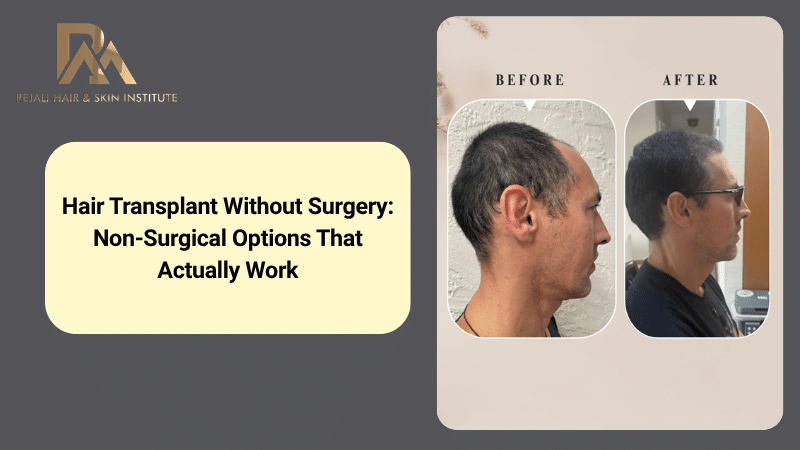
There’s no way to achieve a surgical transplant’s exact result — permanently relocated, independently growing hair — without surgery. But if you’re looking for a hair transplant without surgery, meaning a non-invasive way to address visible hair loss, several legitimate options exist, and they fall into two very different categories: treatments that try to regrow or protect your own hair, and hair replacement systems that cover thinning areas without altering your biology at all.
Medical and Topical Treatments
Minoxidil and finasteride are the most established non-surgical options with real clinical evidence behind them. Minoxidil increases blood flow to the scalp and can extend hair follicles’ growth phase, typically showing results after two to four months of consistent use — though stopping treatment usually reverses the gains within a few months. Finasteride, an oral medication approved for men, has been shown to slow or stop hair loss in a large majority of users over about a year of continued use. Neither restores hair in areas that are already fully bald; both work by supporting follicles that are thinning but still present.
PRP and Regenerative Therapies
Platelet-rich plasma therapy uses concentrated growth factors from your own blood, injected into the scalp to stimulate existing follicles. It’s grouped with newer regenerative options like exosome therapy, which aim to deliver similar growth signals without surgery. These approaches have shown real promise for early-stage thinning, though they typically require repeated sessions and ongoing maintenance rather than a single treatment — our page on PRP facials and scalp therapy covers how this process works in more detail.
Hair Replacement Systems
For patients who want an immediate, fully-covered look without any medical treatment, non-surgical hair replacement systems — toppers, hairpieces, and full systems built from human or synthetic hair — can provide real coverage the same day they’re fitted. These don’t treat the cause of hair loss at all, and poor fit or prolonged wear can itself cause scalp irritation or traction-related thinning, so they work best as a cosmetic solution rather than a treatment plan, especially for hair loss that’s still actively progressing.
Supplements and Lifestyle Support
Vitamins, minerals, and botanical supplements can meaningfully help when hair loss is tied to a genuine nutritional deficiency or hormonal imbalance — but they generally don’t do much for genetic pattern hair loss on their own. Our page on supplements that help with hair growth covers which deficiencies are worth ruling out before relying on this route.
When Non-Surgical Options Aren’t Enough
The honest limitation of every option above is that none of them can restore an area that’s already completely bald, because they all depend on an existing follicle to work with. If your goal is to actually fill in a receded hairline or bald crown rather than slow further loss, a transplant remains the only option that can do that permanently. For many patients, the realistic plan is non-surgical treatment now to protect what’s left, with surgery considered later if the loss progresses beyond what medication can manage.
Key Takeaways
- Non-surgical hair loss treatments fall into two categories: those that support your own hair (minoxidil, finasteride, PRP) and those that cover it (hair systems).
- Medical treatments require ongoing, often indefinite use to maintain results.
- Hair replacement systems provide immediate coverage but don’t treat the underlying cause.
- None of these options can restore hair in an area that’s already fully bald — only a transplant can do that.
FAQ
Is there any non-surgical treatment that regrows hair as well as a transplant? No single non-surgical treatment matches a transplant’s permanence or density in a fully bald area, though combinations of minoxidil, finasteride, and PRP can meaningfully slow or partially reverse early thinning.
How quickly do non-surgical treatments show results? Medical treatments like minoxidil typically take two to four months for visible change; hair replacement systems provide immediate coverage the day they’re fitted.
Can I try non-surgical options before deciding on a transplant? Yes — many patients start with medical treatment to stabilize hair loss and only move to surgery if thinning continues or reaches a point medication can’t address.
To talk through which non-surgical or surgical path fits your hair loss, schedule a free consultation with Dr. Rejali Hair & Skin Institute.