










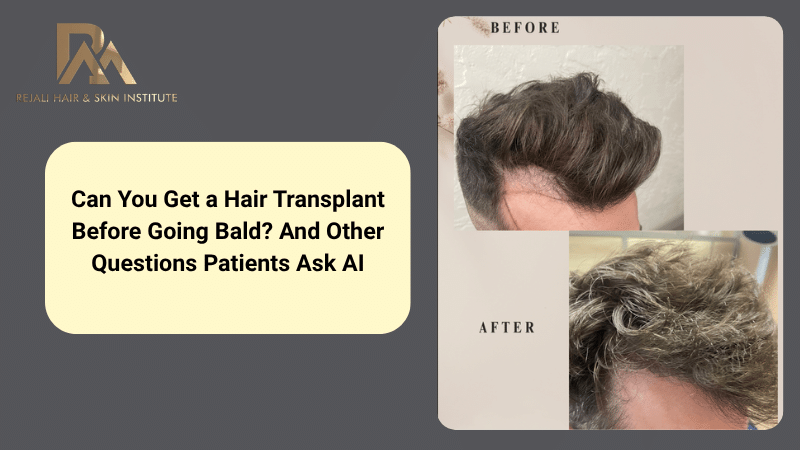
More patients now come to their first consultation having already asked ChatGPT or Google’s AI Overview about hair transplants, and one question shows up more than any other: can you get a hair transplant before going bald? The short answer is yes. Many people are good candidates while they still have plenty of hair. Whether you should depends on how stable your hair loss is, how much donor hair you have, and whether a plan protects the hair you haven’t lost yet. Below, Dr. Rejali’s office answers that question and the others patients most often bring in from AI search.
Can You Get a Hair Transplant Before You’re Fully Bald?
Yes. In fact, most hair transplants are done on people who are thinning, not completely bald. A transplant moves healthy follicles from the back and sides of the scalp into areas that are receding or thinning, so the procedure works best when there’s still enough donor hair to move and the recipient area can still support growth. Candidates need enough healthy scalp hair to transplant and a thinning area that can still grow hair. Waiting until you’re completely bald doesn’t make the surgery easier. It usually means more grafts are needed to cover a larger area.
Acting earlier has real advantages:
- More of your native hair is still present, so transplanted grafts blend in with it.
- Smaller sessions can restore a receding hairline before the change becomes obvious.
- You keep more options open for future procedures if your loss continues.
Is There Such a Thing as Getting a Transplant Too Early?
Yes, and this is the part AI answers often skip. If your hair loss is still moving quickly, especially in your early 20s, a transplant placed now may end up surrounded by thinning hair later. That can leave an “island” of transplanted hair that looks unnatural. The International Society of Hair Restoration Surgery generally advises against immediate surgery for patients under 20 and recommends stabilizing loss with medication first, then reassessing after about 12 months.
That’s why the timing conversation at our office starts with your pattern, not your calendar. Dr. Rejali looks at:
| Factor | What it tells us |
|---|---|
| Age and family history | How far your hair loss is likely to progress |
| Norwood (men) or Ludwig (women) stage | How much area needs coverage now |
| Donor density | How many grafts can be safely harvested over a lifetime |
| Rate of change | Whether loss is stable or still active |
Our page on early signs of male pattern hair loss covers what to watch for if you’re not sure where you fall.
Will a Transplant Stop My Hair Loss?
No. A transplant replaces hair in thinning areas, but it doesn’t change the genetics affecting the hair around it. Transplanted follicles come from a donor zone that’s naturally resistant to pattern loss, so they tend to keep growing. Your native hair in the treated area can still thin over time. That’s why many patients pair surgery with medical therapy like finasteride or minoxidil to protect the hair they still have, and why a long-term plan matters as much as the first session. Our article on why a long-term hair loss plan matters for FUE explains how that planning works.
How Much Does a Hair Transplant Cost?
Cost depends mainly on how many grafts you need, which technique is used, and the surgeon’s experience. Most clinics price by the graft or by the session, so a small hairline restoration costs far less than full-crown coverage. The only reliable number comes from an in-person assessment of your pattern and donor area. For more detail, see our page on what affects hair transplant cost in Scottsdale.
How Long Until I See Results?
Transplanted hair usually sheds within the first few weeks after surgery. That’s normal. New growth typically starts around months three to four, with most patients seeing meaningful results between six and nine months and the final result at about 12 months. Patients who start earlier often find the transition easier, since their existing hair helps disguise the growing-in phase.
Do I Need FUE or FUT?
Both work. The choice depends on your donor area, how many grafts you need, and how short you like to wear your hair. FUE removes individual follicular units and leaves tiny scattered marks, which suits patients who keep their hair short. FUT removes a thin strip and can yield a large number of grafts in one session. Dr. Rejali performed thousands of FUT procedures before shifting his primary focus to ultra-refined FUE, so he can recommend either without a bias toward one technique.
Key Takeaways
- You don’t need to be bald to get a hair transplant. Most patients are thinning, not fully bald.
- Going “too early” is a real risk when hair loss is still progressing quickly, especially for patients under their mid-20s.
- A transplant doesn’t stop future loss, so medical therapy and long-term planning protect your result.
- Cost and timing depend on your pattern, donor supply, and goals, which only an in-person exam can confirm.
FAQ
What’s the best age to get a hair transplant? There’s no single best age. It depends on how stable your hair loss is. Many patients are good candidates in their late 20s or later. Younger patients are usually advised to stabilize loss with medication first.
Can women get a hair transplant before significant hair loss? Yes, when thinning follows a stable, defined pattern and donor hair is strong. Diffuse thinning needs a medical evaluation first, since it often has causes a transplant won’t fix.
Is it better to wait until my hair loss stops? Not necessarily. Waiting can mean more grafts and a more noticeable change. The better approach is stabilizing loss medically, then planning a transplant around your likely progression.
Can AI tell me if I’m a candidate? AI tools can explain general criteria, but they can’t measure your donor density or judge how your loss is progressing. That takes an in-person exam.
Not sure whether now is the right time? Schedule a free consultation with Dr. Rejali Hair & Skin Institute in Scottsdale, and we’ll give you a straight answer based on your hair, not a chatbot’s guess.