










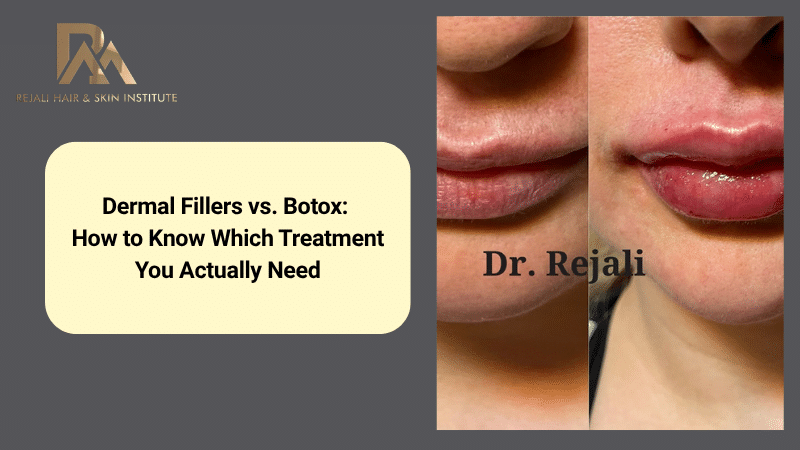
The question of dermal fillers vs. Botox comes up constantly because both are injectable, both are popular, and both get lumped together as “anti-aging treatments” — but they work in completely different ways and solve different problems. Botox relaxes the muscles that cause expression lines; fillers add volume to smooth static wrinkles and restore lost fullness. Knowing which problem you’re actually trying to solve makes the choice much simpler.
What Botox Actually Treats
Botox is a neurotoxin that temporarily blocks nerve signals to targeted facial muscles, reducing the movement that causes expression lines over time. It works best on wrinkles caused by repeated muscle motion — forehead creases, the lines between your brows, and crow’s feet around the eyes are the classic examples. Results typically appear within about two weeks and last three to four months before the muscle activity gradually returns, which is why maintenance treatments are built around that timeline. Our page on wrinkle reduction treatment covers which FDA-approved neurotoxin options are used and how treatment areas are typically selected.
What Dermal Fillers Actually Treat
Fillers work on an entirely different principle: instead of relaxing muscles, they add volume beneath the skin to smooth static wrinkles, restore cheek or lip fullness, and refine facial contours. They’re the better choice for concerns related to volume loss — hollow cheeks, thinning lips, or deepening nasolabial folds — rather than lines caused by muscle movement. Depending on the specific product used, filler results can last anywhere from six months to several years, considerably longer than Botox in most cases. Our page on plumping the face without surgery goes deeper into which areas respond best to filler and what the procedure itself involves.
Why the Two Aren’t Interchangeable
Using Botox on a volume-loss concern, or filler on an expression-line concern, generally produces a disappointing result because neither treatment is built to solve the other’s problem. A deep forehead crease caused by years of muscle movement won’t respond to filler the way it responds to Botox, and hollow under-eyes or thinning lips won’t improve with a neurotoxin no matter how it’s dosed. Part of a good consultation is identifying which category your specific concern actually falls into before recommending either option.
When to Use Both Together
Many patients end up using both treatments, simply because most faces show both types of aging at once — expression lines in some areas and volume loss in others. Botox in the upper face paired with filler in the cheeks or lips is a common combination, and treating both categories together often produces a more balanced, natural-looking result than focusing on just one.
Cost and Commitment Differences
Botox is typically the lower upfront cost per session, but because it only lasts three to four months, the annual cost of maintaining results can add up similarly to filler over time, depending on how many areas you’re treating and which filler product is used. Fillers represent a larger single investment but spread that cost over a longer period between touch-ups. Neither is inherently the better value — it depends on how many areas you want addressed and how long you want to go between appointments.
Key Takeaways
- Botox relaxes muscles to reduce expression lines (forehead, between brows, crow’s feet); fillers add volume to smooth static wrinkles and restore fullness.
- Botox results last three to four months; fillers can last six months to several years depending on the product.
- Using the wrong treatment for your specific concern typically produces disappointing results.
- Many patients combine both, since most faces show signs of aging that each treatment addresses differently.
FAQ
Can I get Botox and filler on the same day? Yes, many patients do — the two treatments work on different structures (muscles versus underlying volume) and are commonly combined in a single visit.
Which lasts longer, Botox or filler? Filler generally lasts longer, anywhere from six months to several years depending on the product, compared to three to four months for Botox.
How do I know if my concern is better suited to Botox or filler? If the wrinkle appears only when you make an expression, it’s typically a Botox candidate; if it’s visible even when your face is at rest, or involves lost volume, filler is usually the better fit — a consultation can confirm which applies to you.
To find out which treatment — or combination — actually fits your face, schedule a free consultation with Dr. Rejali Hair & Skin Institute.