










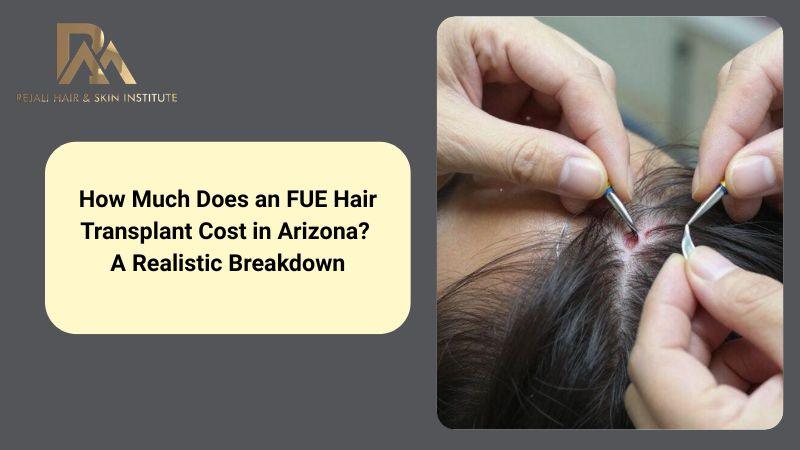
How much does a hair transplant cost? It depends on three things more than anything else: how many grafts your plan needs, which technique is used, and who performs the critical steps of the surgery. At Dr. Rejali Hair & Skin Institute, standard shaved FUE is $4 to $5 per graft and no-shave FUE is $8 to $10 per graft, and every patient gets an exact quote at a free consultation. Below, our team explains what goes into the hair transplant cost for patients in Scottsdale, Phoenix, Tempe, Mesa, Chandler, Gilbert and Glendale, how to compare quotes, and how to tell whether the investment makes sense for you.
How Much Does a Hair Transplant Cost in Scottsdale?
Your price is set by your graft count, the technique (shaved FUE, no-shave FUE or FUT) and the complexity of your case. At our practice, standard shaved FUE is $4 to $5 per graft and no-shave FUE is $8 to $10 per graft. Because your graft count can only be measured in person, Dr. Rejali gives you an exact quote at your free consultation, after examining both the thinning area and your donor area.
Most of the cost comes down to simple math: the number of grafts your plan needs multiplied by the rate for your technique. For example, 2,000 grafts of shaved FUE at $4 to $5 per graft comes to about $8,000 to $10,000, and 3,000 grafts comes to about $12,000 to $15,000. A patient rebuilding a receding hairline often needs around 2,000 grafts. A fuller restoration that covers the front and mid-scalp often needs 3,000 grafts or more. Two people with the same Norwood stage can still end up with different plans, because donor density, hair thickness and curl all change how many grafts it takes to look full.
What Dr. Rejali evaluates before giving you a price
Your quote is built from what Dr. Rejali finds during the exam, not from a menu. At the consultation, he looks at:
- Your pattern of loss. Which areas are thinning, and how advanced the loss is on the Norwood scale (or the Ludwig scale for women).
- Your donor area. How dense and healthy the hair is on the back and sides of your scalp, and how many grafts can be taken safely.
- Your hair itself. Thickness, color, wave and curl all affect how full each graft will look.
- How stable your loss is. If your hair is still changing quickly, the plan needs to account for future loss.
- Your history. Earlier transplants, scars and medical conditions that affect healing.
- Your goals. A natural, age-appropriate result for you, not a one-size-fits-all hairline.
Once those pieces are clear, you’ll get an estimated graft count, a recommended technique and an exact price for your plan.
Our guide to how many grafts you need walks through typical graft ranges by Norwood stage, so you can get a feel for where your plan may land before you come in.
What Drives the Price of a Hair Transplant?
Five factors explain most of the difference between one patient’s price and another’s: graft count, technique, how much of the surgery the doctor performs personally, case complexity and the condition of your donor area. Each one changes how much time, skill and staff a procedure takes.
| Cost factor | Why it changes the price |
|---|---|
| Graft count | More grafts mean more extraction and placement time. This is the single biggest factor. |
| Technique | FUE removes each graft one at a time, which takes longer than FUT. No-shave FUE takes longer still. |
| Surgeon involvement | A surgeon who personally performs hairline design, extraction and recipient sites limits how many patients can be treated in a day. |
| Case complexity | Revision work, scar tissue and tightly curled or Afro-textured hair take more skill and more time. |
| Donor availability | A thinner donor area may call for a smaller, more careful harvest or a staged plan. |
| Women’s diffuse thinning | Placing grafts between existing hair across a wide area takes extra precision. |
Graft count
Graft count is the largest driver. A small hairline refinement and a front-to-crown restoration are very different procedures, and the price reflects that. At your consultation, Dr. Rejali maps the areas to be treated and gives you an estimated graft count, so you know exactly what you’re paying for.
Technique: FUE, FUT and no-shave FUE
FUE (follicular unit extraction) removes grafts one by one with a tiny punch, leaving small pinpoint scars that are easy to hide with short hair. FUT removes a strip of scalp and leaves a linear scar, but can move many grafts at once. No-shave FUE adds time because the surgeon works around longer hair. Our no-shave FUE guide explains why that option costs more.
Surgeon involvement
At high-volume clinics, technicians often perform much of the surgery. At our practice, Dr. Rejali performs every step of the procedure himself, from hairline design and graft extraction to recipient site creation and graft placement. That level of physician involvement is part of what you’re paying for.
Case complexity
Revisions of earlier transplants, grafts placed into burn, trauma or surgical scar tissue, and tightly curled hair all take more planning and time. Dr. Rejali regularly takes on these cases, and they’re priced to reflect the extra work. Facial hair is priced on the same principles; our guide to beard transplant cost and results covers what changes for beard work.
Price per Graft vs. Package Pricing
Clinics price hair transplants in one of two ways: a rate per graft, or a package price for a session or a treatment area. Per-graft pricing shows clearly how the total was built. Dr. Rejali Hair & Skin Institute prices by the graft: $4 to $5 per graft for standard shaved FUE and $8 to $10 per graft for no-shave FUE. Package pricing can be simpler to understand, but only if the package states how many grafts it includes.
Neither model is better on its own. What matters is that the quote ties a dollar figure to a specific number of grafts and a specific treatment area. A package that says “full hairline” without a graft count makes it hard to compare with another clinic’s quote. If a clinic quotes a package, ask how many grafts it covers and what happens if more or fewer grafts are needed on the day.
Why the Cheapest Quote Can Cost More
A low quote can end up costing more if fewer grafts survive, if the hairline looks unnatural, or if the donor area is overharvested. Fixing a poor transplant is often harder and more expensive than doing it well the first time, because the donor supply that was used can’t be replaced.
When you pay for a hair transplant, you’re paying for hair that grows, not grafts that are moved. A careful procedure protects more grafts during extraction and placement, so more of them grow. Here’s what a higher-quality fee typically covers:
- Physician-performed steps. Dr. Rejali performs every step himself, including hairline design, extraction, recipient sites and graft placement.
- Refined extraction tools. We use small hybrid micro-punches, including the WAW FUE system, chosen to match each patient’s hair.
- Graft handling. Grafts are kept in holding solution and handled carefully between extraction and placement.
- Medical-grade supplies and a proper surgical setting.
- Local follow-up care. You can come back to our Scottsdale office if you have a question during recovery.
Poor work also has a cost you can’t see on the invoice. An unnatural hairline, a patchy donor area or wasted grafts can limit what a future surgeon is able to do. Dr. Rejali sees this regularly in revision patients who come to us after a procedure elsewhere.
How to Compare Hair Transplant Quotes
Compare quotes like for like: the same graft count, the same treatment areas, the same technique and a clear answer about who performs each step. A lower number that leaves out any of these isn’t really a lower price. Ask every clinic to put these details in writing.
What a quote should include
- Estimated graft count and the areas being treated
- The technique (FUE, FUT or no-shave FUE)
- Who designs the hairline, extracts the grafts and creates the recipient sites
- What’s included: medications, supplies, follow-up visits and post-op care
- Whether a second session is likely, and how it would be priced
- Payment and financing terms
Red flags in a quote
- A price far below the market. Very low pricing often means technicians, not the doctor, perform most of the surgery.
- A promise that one session will be enough. An honest surgeon explains what density is realistic and when a second session might help.
- Pressure discounts. A discount that expires when you leave the room is a sales tactic, not a medical recommendation.
- No answer about who does what. You should know exactly who will be working on your scalp.
- A quote without an exam. A number given from a few photos is a guess.
For a fuller checklist, see our guide on how to choose a hair transplant surgeon and clinic.
Other Costs to Plan For
Beyond the surgery fee, plan for a few smaller costs: medications or treatments that protect your native hair, optional add-ons such as PRP, time off work, and possibly a second session in the future. Ask what’s included in your quote so nothing surprises you later.
| Possible added cost | What to know |
|---|---|
| Hair loss treatment | Many patients continue a treatment plan to protect the hair they haven’t lost yet. |
| PRP | Some patients add PRP for hair alongside their transplant. |
| Time off work | Depending on your job, you may be back at work the day after surgery or after a few days. |
| Future sessions | If your hair loss continues, a second session may be planned months or years later. |
The consultation itself isn’t one of these costs. It’s free and doesn’t commit you to anything.
Payment Plans and Financing
Yes, you can spread the cost of a hair transplant over time. Dr. Rejali Hair & Skin Institute offers payment plans for hair restoration procedures, and our team reviews your options during the consultation so you know your monthly cost before you decide.
Patients generally pay in one of three ways: in full, through a medical financing plan with set monthly payments, or with a combination of savings and financing. Before you sign up for any financing plan, check the interest rate, how long any promotional rate lasts and whether there’s a penalty for paying early.
Is a Hair Transplant Worth It?
For good candidates, a hair transplant often costs less over 10 to 20 years than the alternatives people use to hide hair loss. It’s not right for everyone, though. Whether it’s worth it for you depends on your donor supply, how stable your hair loss is and what result you expect.
How the long-term cost compares
Many people spend money on hair loss every year without realizing how quickly it adds up. Hairpieces and hair systems often run about $1,200 to $3,000 a year to buy, maintain and replace. Hair fibers and concealers often run about $300 to $600 a year. Over a decade or two, those costs can match or pass the price of a transplant, and they stop working the day you stop paying for them. Transplanted follicles, on the other hand, typically keep growing for years.
The limitations to weigh
| Limitation | What it means for you |
|---|---|
| Finite donor supply | You can only move so many grafts in a lifetime, so the plan has to be used wisely. |
| Native hair keeps thinning | A transplant doesn’t stop ongoing hair loss in untreated areas. |
| Results take time | Most patients wait about 12 months to see the full result. |
| More sessions may be needed | Some patients need a second session for density or for future loss. |
Who gets the best outcomes
The best candidates have a healthy donor area, hair loss that has slowed or stabilized, realistic expectations and a long-term plan that protects their remaining hair. A transplant may not be worth it yet if your hair loss is changing quickly, if your donor supply is very limited, or if you expect a full head of hair from a small number of grafts. In those cases, Dr. Rejali may recommend treating and stabilizing the loss first.
Like any surgery, a hair transplant carries risks. These include swelling, temporary numbness, infection, folliculitis (inflamed follicles), temporary shedding of nearby native hair (shock loss) and grafts that don’t grow as expected. Cleveland Clinic also notes that some patients need several procedures to reach the fullness they want, with months of healing between them, so it’s worth budgeting with that possibility in mind. Our recovery timeline guide explains what to expect after surgery.
Key Takeaways
- Hair transplant cost depends mostly on graft count, technique, surgeon involvement and case complexity.
- At Dr. Rejali Hair & Skin Institute, standard shaved FUE is $4 to $5 per graft and no-shave FUE is $8 to $10 per graft, with an exact quote at your free consultation.
- Compare quotes on graft count, treatment area, technique and who performs each step, not on the bottom line alone.
- The cheapest quote can cost more if grafts don’t survive or the donor area is overharvested.
- Payment plans are available, and the consultation is free.
Frequently Asked Questions
How much does a hair transplant cost in Scottsdale? At our practice, standard shaved FUE is $4 to $5 per graft and no-shave FUE is $8 to $10 per graft, so a 2,000-graft shaved FUE procedure is about $8,000 to $10,000. Dr. Rejali gives your exact quote at a free consultation.
Is a hair transplant priced per graft? Often, yes. Many clinics price per graft, and others use package pricing for a session or area. Either way, ask how many grafts the price covers. Our practice prices per graft.
Why can’t I get an exact price without a consultation? Your donor density, hair thickness, curl and the stability of your hair loss all change your plan. These can only be measured accurately in person.
Are there costs beyond the surgery fee? Possibly. Ongoing hair loss treatment, optional PRP, time off work and a future session are the most common. Ask what your quote includes.
Does insurance cover hair transplants? Cosmetic hair transplants generally aren’t covered. Reconstructive cases, such as hair loss from burns or trauma, may be handled differently, so check with your insurer.
Do you offer payment plans? Yes. Dr. Rejali Hair & Skin Institute offers payment plans, and our team reviews the options with you at your consultation.
Why does no-shave FUE cost more? Working around longer hair takes more time, more precision and often more staff. At our practice, no-shave FUE is $8 to $10 per graft, compared with $4 to $5 for shaved FUE.
Does FUE cost more than FUT? Usually, yes. FUE removes each graft individually, which takes longer. In exchange, it leaves small pinpoint scars instead of a linear scar.
Are cheap hair transplants safe? Not always. Very low pricing often means technicians perform most of the surgery. Ask who does each step before you book.
Get an Exact Price at Your Free Consultation
Our patients rate us 5 stars on Yelp and RealSelf and 4.9 stars on Google. A range online can only tell you so much. At a free, no-pressure consultation, Dr. Rejali examines your scalp and donor area, maps your treatment plan and gives you an exact price, along with your payment plan options. Call or text our Scottsdale office at 480-945-2688, or send us a message through our contact form, and we’ll help you find a time that works.