










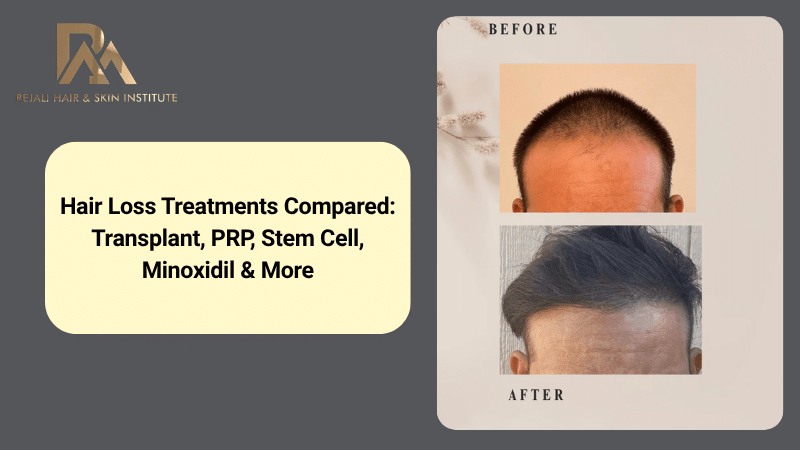
A quick hair loss treatments comparison comes down to one fact: no single option works the same way for every type of hair loss, so the “best” treatment depends entirely on your pattern, your goals, and how permanent you want the result to be. Surgical hair transplants permanently relocate your own growing follicles, while PRP, topical medications, and regenerative therapies work by trying to protect or stimulate the hair you still have. Understanding what each one actually does — rather than what it promises — is the difference between a frustrating cycle of trial and error and a plan that fits your situation the first time.
Hair Transplant Surgery
A hair transplant, whether performed with FUE (individual follicular units) or FUT (strip harvesting), physically relocates hair from a genetically resistant donor area to thinning or bald areas. It’s the only option on this list that creates a permanent, independently growing result rather than supporting hair that’s still present. It’s also the most involved choice, requiring a surgical procedure, a recovery period, and a realistic view of how much donor hair is available to work with — our guide on hair transplant vs. non-surgical treatments goes deeper into when surgery makes sense versus when it doesn’t.
Platelet-Rich Plasma (PRP) Therapy
PRP uses concentrated growth factors from your own blood, injected directly into the scalp to stimulate existing follicles. It’s grouped with “regenerative” treatments because it works with your biology rather than adding synthetic hair or medication — research has described it as showing genuine promise for androgenetic alopecia, though it typically requires a series of sessions and ongoing maintenance to sustain results. PRP is sometimes used on its own for early thinning, and sometimes alongside a transplant to support graft survival and surrounding native hair.
Stem Cell and Regenerative Therapies
Newer regenerative approaches, including exosome therapy, aim to deliver growth signals to hair follicles in a way that’s less invasive than surgery. These treatments are still considered experimental relative to transplants or minoxidil, with less long-term data available, but early interest has grown because they target the biology of thinning hair rather than simply covering it up. Our page on exosome therapy for hair restoration covers what the current evidence does and doesn’t support.
Minoxidil and Other Topical or Oral Medications
Minoxidil (commonly known by the brand name Rogaine) is one of the most widely used treatments for both men and women, working by increasing blood flow to the scalp and extending the hair growth cycle. It typically takes two to four months of consistent use before any improvement appears, and the effect isn’t permanent — stopping use generally leads to shedding the regrown hair within a few months. Finasteride, an oral medication FDA-approved for men, has shown strong results in slowing hair loss and, in some cases, regrowing hair over about a year of continued use. Both require ongoing commitment rather than a one-time fix.
Supplements and Nutritional Support
Hair-growth supplements containing vitamins, minerals, and botanical ingredients like saw palmetto tend to help most when hair loss is tied to a nutritional deficiency or hormonal imbalance rather than genetic pattern loss. They’re rarely a standalone solution for significant thinning, but they can meaningfully support results from other treatments when an underlying deficiency is actually present.
How to Choose Among These Options
The right starting point is an honest look at what’s causing your hair loss and how far it’s progressed — a genetic, stable pattern responds differently than diffuse thinning tied to stress, hormones, or a medical condition. Early-stage thinning often responds well to medical and topical options alone, while more advanced or long-stable loss is usually where surgical restoration becomes the more realistic path to a lasting result. Combining approaches — minoxidil alongside a transplant, for example — is common and often more effective than relying on any single treatment.
Key Takeaways
- Hair transplants are the only permanent, independently-growing solution; most other treatments support or protect existing hair rather than replace it.
- PRP and regenerative therapies like exosome treatment work with your own biology but usually require ongoing sessions.
- Minoxidil and finasteride are effective for many patients but require indefinite use to maintain results.
- The right treatment depends on your specific cause of hair loss, not which option is most heavily advertised.
FAQ
Which hair loss treatment works the fastest? Minoxidil and finasteride can show initial results in two to four months, while surgical results take considerably longer to mature but don’t require continued daily treatment to maintain.
Can I combine a hair transplant with other treatments? Yes — many patients use minoxidil, PRP, or similar therapies alongside a transplant to help protect native hair that wasn’t part of the surgical plan.
Is PRP a substitute for a hair transplant? Not for significant bald areas. PRP works best on hair that’s thinning but still present, since it stimulates existing follicles rather than creating new ones.
To find out which combination of treatments fits your hair loss pattern, you can schedule a free consultation with Dr. Rejali Hair & Skin Institute in Scottsdale.