










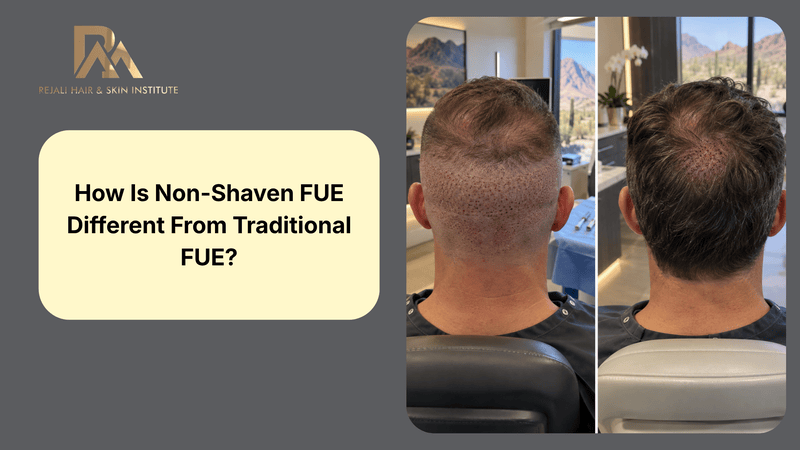
How Is Non-Shaven FUE Different From Traditional FUE?
The practical difference comes down to preparation, not the underlying surgical technique. Traditional FUE usually calls for more extensive trimming or shaving of the donor and recipient areas before extraction begins. Non-shaven FUE, by contrast, preserves most of the surrounding hair throughout the process.
Both approaches still involve extracting individual follicular units and placing them one at a time, so the core surgical method doesn’t change between them. What changes is visibility.
Because the difference is mainly about hair preparation and how noticeable the treatment is to other people, it shapes the recovery experience more than it changes the biology of healing underneath it.
That distinction matters when choosing between the two. A patient deciding based on healing speed alone may be solving for the wrong variable, since the more relevant question is usually how much visibility during recovery someone is comfortable with.
What Does the Non-Shaven FUE Recovery Timeline Look Like?
Recovery unfolds gradually, and most patients move through the same general phases regardless of technique.
| Timeframe | What Typically Happens |
| First few days | Mild redness, tenderness, swelling, or small scabs around grafts, which need to be protected carefully |
| First 1 to 2 weeks | Scabbing gradually resolves; longer surrounding hair may help conceal treated areas during this stretch |
| First few months | Temporary shedding of transplanted hairs is expected, followed by the earliest signs of new growth |
| 6 to 12 months | Density continues to increase as grafts mature, with results still developing throughout this window |
Patients generally return to normal routines gradually during the first couple of weeks, based on guidance from their surgeon rather than a fixed calendar date.
Why Recovery May Feel More Discreet With Non-Shaven FUE
Because most of the surrounding hair stays in place, it can help camouflage several visible signs of recent treatment, including:
- Donor sites where follicles were extracted
- Redness in the recipient area
- Early scabbing before it resolves
That camouflage effect also means the change in hairstyle is often less obvious to coworkers or family, which is part of why non-shaven FUE tends to appeal to professionals and public-facing patients. Browsing real recovery and results photos can help set expectations for how visible each stage typically is.
One caveat matters here: non-shaven doesn’t mean invisible. Redness and scabbing can still occur, and how noticeable they are depends on individual healing, skin tone, and how closely someone is looking.
Does Non-Shaven FUE Heal Faster Than Traditional FUE?
Keeping the surrounding hair unshaven doesn’t speed up the underlying biological healing process, even though it often makes that process easier to keep private.
Actual healing time depends on several factors working together, including the number of grafts placed, the size of the treatment area, individual scalp characteristics, and how closely aftercare instructions are followed.
Discretion, rather than faster healing, is the more accurate way to describe the practical advantage non-shaven FUE offers most patients during recovery.
Setting expectations around discretion instead of speed also helps patients plan recovery time off more realistically, since a healing timeline built around an inaccurate assumption tends to cause unnecessary frustration partway through.
How to Support Non-Shaven FUE Healing
Whichever technique is used, a few habits consistently support smoother healing:
- Follow washing and aftercare instructions exactly as provided
- Avoid rubbing, scratching, or picking at healing grafts
- Hold off on strenuous activity until your surgeon clears it
- Protect the scalp from unnecessary irritation and direct sun exposure
Following individualized guidance from your surgeon matters more than any general checklist, since healing timelines vary from one patient to the next. For a fuller month-by-month breakdown, the general FUE recovery timeline covers what to expect at each stage in more depth.
What This Means for Your Recovery
Non-shaven FUE offers a different recovery experience than traditional FUE, not an entirely different healing process underneath it. The advantage lies mainly in discretion and in keeping more of your existing hair intact along the way.
If you’re weighing recovery expectations as part of choosing a technique, Dr. Rejali Hair & Skin Institute can walk you through what non-shaven FUE would look like for your specific hair and goals.
Scheduling a free consultation is the most direct way to get answers specific to your situation.
Frequently Asked Questions
-
How long is the recovery time after non-shaven FUE?
Most patients see scabbing resolve within one to two weeks, temporary shedding and early regrowth over the following few months, and continued density gains through the six to twelve month mark. Full results typically take up to a year to become fully visible.
-
Does non-shaven FUE heal faster than traditional FUE?
No, not biologically. The underlying healing timeline is largely the same between the two approaches. What differs is how discreet recovery feels, since surrounding hair left in place can help conceal redness and scabbing along the way.
-
Will people be able to tell I had non-shaven FUE during recovery?
It’s often less noticeable than traditional FUE because existing hair helps camouflage treated areas, but it isn’t guaranteed to be invisible. Redness or scabbing can still be visible depending on individual healing and how closely someone looks.
-
When can I wash my hair after non-shaven FUE?
This depends on your surgeon’s specific instructions, which typically outline a gentle washing routine beginning within the first several days. Following those instructions precisely matters more than any general timeline, since early graft care affects healing.
-
When does transplanted hair start growing after non-shaven FUE?
Early shedding of transplanted hairs is normal in the first few weeks and isn’t a sign of failure. Visible new growth generally begins within a few months, with density continuing to build over the following months as grafts mature.