










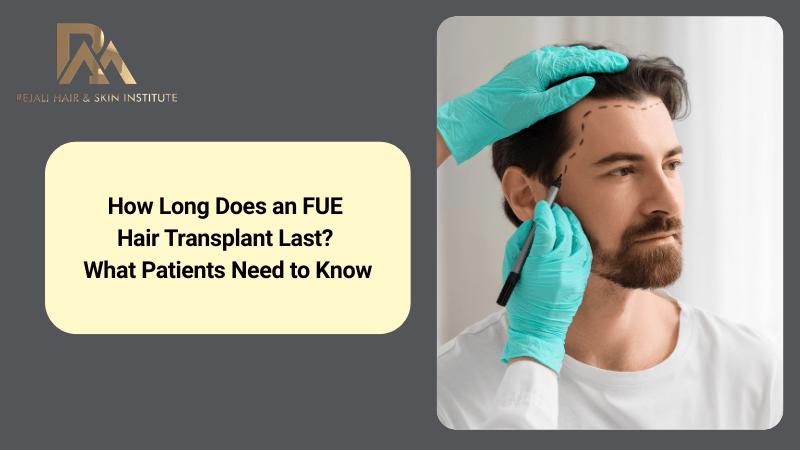
How Long Does an FUE Hair Transplant Last? What Patients Need to Know
If you’re researching hair restoration, one question likely tops your list: how long does FUE hair transplant last? The short answer is that transplanted follicles are designed to keep growing for decades — often for life. But long-term success also depends on your biology, your surgeon’s skill, and how well you maintain both your transplanted and native hair over time.
Why FUE Results Are Considered Permanent
An FUE hair transplant isn’t a temporary fix — it’s a permanent redistribution of your existing hair. Follicles are harvested from the back and sides of the scalp, the “safe zone” that stays genetically resistant to dihydrotestosterone (DHT), the hormone behind pattern hair loss.
Here’s the biological cornerstone: transplanted follicles carry their original genetic instructions to their new home. This principle, called donor dominance, means the hair keeps growing as it did at the back of your head — even if the surrounding scalp continues to thin. That’s why results are designed to endure for decades rather than a few years.
What Determines How Long Your Results Last
Surgeon skill and technique. Precision in harvesting and placing each graft directly influences how well follicles integrate and thrive. At Rejali Medical, Dr. Rejali personally performs every critical step — hairline design, graft extraction, and recipient site creation — using hybrid micro-punch technology that minimizes trauma and keeps transection rates low. Superior technique gives every graft the best possible start.
Your age and hair loss trajectory. Natural hair loss doesn’t stop because you had surgery. Younger patients may see their thinning pattern evolve significantly over the next two decades, so comprehensive long-term planning is vital. Native hair can continue thinning around the transplanted sites if the underlying condition progresses.
Donor hair quality. Density, texture, and follicle diameter all vary from person to person. High-quality donor hair yields fuller coverage, and your surgeon will confirm your donor zone can supply the needed volume without visible thinning at the back of your head — while preserving reserves for potential future work.
The Growth Timeline: From Shedding to Maturity
Understanding the recovery timeline sets realistic expectations:
- Weeks 1–4: Most transplanted hair shafts shed as the follicles enter a resting phase. This is completely normal — the follicle itself remains safely embedded and healthy.
- Months 3–4: New, fine hairs begin emerging, a sign the grafts are well-integrated and functioning.
- Months 4–6: Hairs thicken and darken, and the improvement becomes noticeable to others.
- Months 12–15: The hair reaches terminal thickness and full length — your final result.
Patience through the full growth cycle is key to appreciating the finished look.
How to Protect Your Investment
While the transplanted follicles are hardy, a dedicated approach to scalp health supports both your transplanted and native hair. The table below summarizes the core maintenance categories:
| Maintenance Area | Focus Strategy | Objective |
|---|---|---|
| Scalp Care |
Consistent cleaning |
Promote skin health |
| Medication |
Topical application |
Support graft survival |
| Lifestyle |
Nutrition and hydration |
Nutrient support |
Within each category, a few specific habits make the biggest difference:
- Consider FDA-approved medications. Approved therapies help stabilize your native hair, protecting the density surrounding your new grafts and producing a more natural result as you age.
- Support your scalp with lifestyle basics. A nutrient-rich diet, good hydration, and consistent scalp hygiene give follicles the building blocks they need. Avoid harsh chemicals and excessive heat styling.
- Protect against trauma and sun stress. During the first year especially, avoid tight headwear, direct scalp trauma, and prolonged sun exposure, and keep daily grooming gentle.
- Schedule regular check-ins. Professional monitoring catches early signs of inflammation or new thinning, allowing timely intervention before regression takes hold.
Managing Expectations for Future Thinning
Surgery changes the position of your hair — not the underlying trajectory of genetic hair loss. Transplanted hair behaves like donor hair, but native hair remains subject to your original thinning pattern. If untreated areas recede over the years, the overall aesthetic can shift.
This is exactly why a long-term roadmap matters. Some patients choose a secondary procedure years later to add density or address new recession — a common and effective way to keep results full through different stages of life. Discussing your donor capacity early helps determine whether future expansion is an option.
Signs of a Successful, Lasting Result
A well-executed transplant should feel organic: consistent pigment and thickness that match the surrounding hair, growth angles that mimic your natural pattern, and texture that behaves exactly like native hair when styling. A thoughtfully designed hairline also ages gracefully — respecting your facial structure so it still looks authentic decades from now.
Frequently Asked Questions
Is an FUE hair transplant permanent? Yes. The harvested follicles come from areas genetically resistant to hair loss, so they typically continue growing for the rest of your life.
Can I still lose hair after a transplant? The transplanted hair is permanent, but native hair around the grafts can continue thinning due to the natural progression of androgenetic alopecia.
How long until I see final results? Early growth begins within a few months, with final density and maturity typically reached by 12 to 15 months.
Will I need a touch-up procedure later? Some patients opt for secondary procedures years down the road to add density or address new areas as their hair loss pattern evolves.
Does the shedding phase mean my grafts failed? No. Early shedding is a standard part of the growth cycle — the follicle remains healthy and will produce new, permanent hair.
Will transplanted hair look different from my original hair? When performed properly, it’s indistinguishable — the hair adopts the same growth patterns and texture once it matures.
So, how long does an FUE hair transplant last? With skilled surgical technique, healthy donor follicles, and consistent maintenance, your results can genuinely last a lifetime. Schedule a consultation with Rejali Hair & Skin Institute in Scottsdale to learn what a long-term restoration plan would look like for you.