










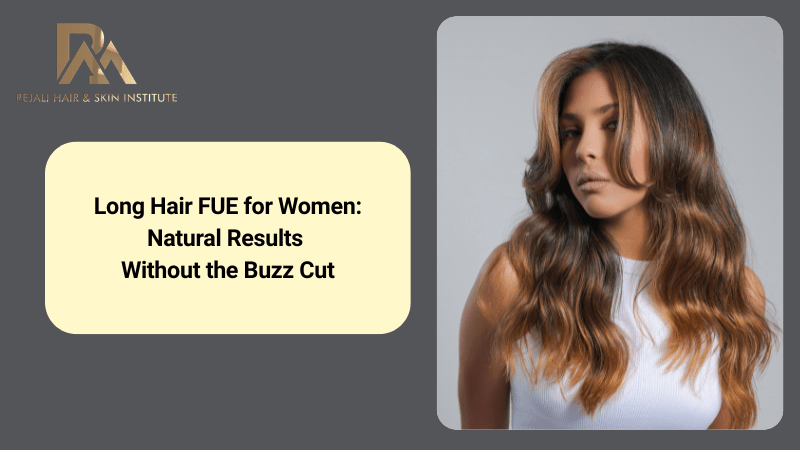
Long Hair FUE for Women: Natural Results Without the Buzz Cut
For many women, hair is inseparable from personal identity — which is why the thought of shaving for a hair transplant is often the single biggest barrier to seeking help. Long hair FUE removes that barrier entirely. The technique restores density without trimming the donor or recipient areas, and the long hair FUE results women achieve are both immediate in appearance and permanent in nature.
What Is Long Hair FUE?
Long hair FUE is a specialized, no-shave method for extracting and transplanting hair follicles while your natural length stays intact. Standard FUE typically requires shaving the back and sides of the head, which gives the surgeon maximum visibility but forces a temporary change in hairstyle. The non-shaven version lets you walk out of the clinic looking much like you did when you arrived.
Here’s how the two approaches compare:
| Feature | Standard FUE | Long Hair FUE |
|---|---|---|
| Preparation |
Fully shaven |
No shaving required |
| Recovery visibility |
More noticeable |
Highly discreet |
| Styling flexibility |
Limited initially |
High immediately |
For women managing female pattern hair loss, that discretion matters. The donor sites stay hidden beneath your existing hair, so you can return to work and social settings without drawing attention to your scalp.
Why Women Choose the Non-Shaven Approach
Complete privacy during recovery. Your existing hair acts as a natural curtain over the post-operative sites, concealing any redness or healing marks. Personal and professional life continues with minimal interruption.
Instant visualization of results. Because hairs are transplanted at full length, you get an immediate sense of your final density and hairline. Surgeons benefit too — the long grafts show exactly how angle and thickness align with your natural texture, informing more precise placement.
A lower emotional hurdle. Removing the buzz-cut requirement removes much of the anxiety around the procedure itself, making the decision to move forward far easier.
How the Procedure Works
Careful donor extraction. With the hair left long, extraction demands a more refined touch to avoid damaging neighboring strands. The team at Rejali Medical sections the hair precisely to expose target follicles, uses specialized tools to protect the long shafts, and keeps the surgical field sterile — all while leaving the donor area visually undisturbed.
Artistic recipient placement. Placement is where precision becomes artistry. Each graft is mapped to match the existing flow of your natural growth, with the visible hair length allowing the surgeon to fine-tune the angle and orientation of every insertion. Dr. Rejali personally performs hairline design, graft extraction, and recipient site creation for every patient.
Once extraction is complete, your hair is styled back over the area — leaving no detectable sign of the work performed.
Are You a Candidate?
Women typically experience diffuse thinning rather than the receding hairline common in men, so the surgical plan must be highly personalized. Candidacy hinges on:
- Your hair loss pattern. A thorough scalp assessment maps where density is needed and creates a blueprint that maximizes natural volume.
- Donor site density and length. Your donor area must supply enough healthy grafts without leaving gaps behind — a qualified surgeon evaluates this carefully during consultation.
- Scalp preparation. In the weeks before surgery, you may be asked to strengthen existing strands with prescribed treatments and avoid harsh chemical processing that could irritate the scalp.
Recovery and Results Timeline
Mild swelling around the forehead or eyes is normal in the first few days; hydration and the recommended sleeping position ease it quickly. You’ll receive gentle washing and styling protocols for the first week to keep the newly placed follicles secure.
Expect an initial shedding phase — transplanted hairs fall out as the roots settle in, then fresh, permanent growth emerges over the following months. Long-term, many patients support their results with growth-promoting therapies like low-level laser therapy (LLLT), a healthy diet, and routine check-ups to keep both native and transplanted hair thriving.
One note on expectations: while it’s tempting to aim for maximum thickness in a single session, a strategic focus on balanced, stable density typically yields the most natural results over the years.
Frequently Asked Questions
Is long hair FUE suitable for every woman? Suitability depends on your donor hair quality and degree of thinning. A consultation is needed to confirm the technique can deliver the density you’re seeking.
How long is recovery? Most women return to normal routines within a few days. With no shaving involved, the post-operative appearance stays discreet from day one.
Is the transplanted hair permanent? Yes. Follicles are harvested from areas of the scalp resistant to thinning, and they retain those properties for life once transplanted.
Will there be visible scars? The technique uses advanced instrumentation that creates pin-sized extraction sites, which are covered by your existing hair — scarring is virtually undetectable even up close.
Is the procedure painful? Most patients report minimal discomfort. The procedure is performed under local anesthesia, and any post-surgical soreness is typically managed with over-the-counter options.
Can I style, cut, and color the new hair? Absolutely. Transplanted hair behaves exactly like your natural hair once fully grown, so you keep complete styling freedom.
Regain Your Confidence
The long hair FUE results women see combine the best of both worlds: permanent restoration with no buzz cut, no obvious recovery period, and a final look that blends seamlessly with your natural hair. If you’re ready to explore whether you’re a candidate, schedule a consultation with Rejali Hair & Skin Institute in Scottsdale for a personalized assessment of your hair loss pattern and donor density.