








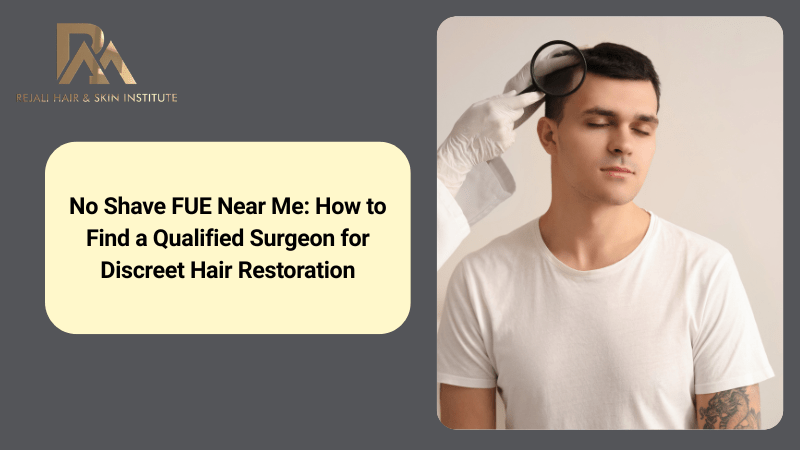
No Shave FUE Near Me: How to Find a Qualified Surgeon for Discreet Hair Restoration
If you’ve been searching “no shave FUE near me,” you already know what you want: hair restoration without a shaved head, visible downtime, or explanations at the office. What you may not know is how to separate a genuinely qualified no-shave specialist from a clinic that simply markets the term. This guide walks you through exactly what to look for — and what to avoid.
Why the No-Shave Technique Demands a Specialist
In standard FUE, the entire donor zone is shaved so the surgeon has easy access to individual follicular units. In a no shave FUE hair transplant, the surgeon selectively trims only the specific follicles being harvested, leaving the surrounding hair long enough to cover the extraction sites immediately.
That difference sounds small. Surgically, it isn’t. Working around intact hair demands significantly more time, precision, and manual dexterity — which means not every clinic advertising FUE can actually execute the no-shave version well. Ideal candidates typically have early to moderate thinning, adequate donor density, and hair long enough to provide camouflage, all of which a qualified surgeon will assess honestly before recommending the approach.
The Credentials That Actually Matter
When you’re comparing local providers, look past the marketing to verifiable qualifications:
Board certification in hair restoration. Prioritize surgeons certified by the American Board of Hair Restoration Surgery (ABHRS) — the recognized specialty board for this field. Dr. Rejali at Rejali Medical earned his ABHRS Diplomate status in 2010 after written and oral examinations, and later served as an oral protocol examiner for the Board itself.
Specialized no-shave training and volume. Ask directly about the surgeon’s experience with advanced extraction methods and how many unshaven procedures they’ve performed. These techniques require far more dexterity than standard FUE, and experience is what protects your grafts.
Who actually does the surgery. At many clinics, technicians perform most of the extraction and placement. Ask which steps the surgeon personally handles. Dr. Rejali performs every critical step himself — hairline design, graft extraction, and recipient site creation — and deliberately avoids automated harvesting systems, which use larger punches and produce higher transection rates.
A portfolio you can scrutinize. Visual evidence is the clearest indicator of a surgeon’s aesthetic judgment. Look for clear, well-lit before-and-after photos across a variety of hair types and thinning patterns, with results that appear dense and uniform. For no-shave work specifically, check that donor areas look untouched.
Consistent patient feedback. Reviews reflect individual outcomes, not guarantees — but patterns in communication, responsiveness, and post-operative care tell you a lot about how a clinic will treat you during recovery.
Red Flags to Watch For
Some warning signs should end your evaluation of a clinic immediately:
- Universal promises. Any provider guaranteeing identical results for every patient is ignoring the personalized scalp analysis that legitimate planning requires.
- Price-first marketing. Clinics leading exclusively with discounts or “quick fix” messaging often cut corners on the time-intensive precision no-shave work demands.
- Reluctance to discuss risks. If a surgeon won’t talk through the limitations of your hair growth pattern, donor capacity, or the technique itself, treat that hesitation as your answer.
Questions to Ask at Your Consultation
Arrive prepared and you’ll leave with real information instead of a sales pitch:
- How many grafts do you estimate for my goals, and how did you arrive at that number?
- Which team members handle extraction and placement, and what does the surgeon personally perform?
- How will you preserve my donor density for potential future procedures?
- Can I see no-shave cases similar to my hair type and thinning pattern?
- What does your quote include — and what costs sit outside it?
A thorough consultation should also include a scalp assessment, a review of your medical history and any previous thinning treatments, and a mapped surgical plan showing where grafts will be placed to mimic your natural pattern.
What to Expect on Cost and Recovery
No-shave FUE is priced higher than traditional shaved sessions because of the added time and technical demand — a quality-focused surgeon prices for precision, not just follicle count. Your final quote depends on graft volume, case complexity, and the artistry involved; our guide to no shave FUE cost breaks down every factor.
Recovery is refreshingly uneventful. The donor zone is discreet immediately, though mild swelling or redness near the extraction sites can last a few days beneath your existing hair. Most patients return to light professional activity within days, holding off on strenuous exercise for at least a week. From there, growth follows the standard curve — a resting phase, then new development, with final density emerging over the following year.
Searching in the Phoenix Metro Area?
For patients in Scottsdale, Tempe, Mesa, Chandler, Gilbert, and Glendale, Rejali Medical offers no-shave FUE performed personally by Dr. Farhad Rejali — a dual-trained physician with 20+ years in practice, more than 6,000 procedures performed, and ABHRS board certification. Patients travel from across the country for his hands-on approach; if you’re local, the search for “no shave FUE near me” may end a short drive away.
Frequently Asked Questions
Does no-shave FUE take longer than a standard procedure? Yes — working precisely around existing follicles adds meaningful time to the surgical day compared to a shaved session.
Will the donor area look normal right after surgery? Largely, yes. Mild swelling or redness near extraction sites can persist for a few days, but your natural hair length masks these areas from view.
Can any hair transplant clinic perform no-shave FUE? No. The technique requires specific training and a high level of surgical skill to harvest follicles without damaging surrounding hair — specialization matters.
Is the result permanent? Yes. Transplanted follicles are generally resistant to the genetic factors behind the original hair loss, so results are permanent with proper graft handling.
How soon can I return to work? Most patients resume light professional activities within a few days, avoiding strenuous activity and direct sun on the scalp for at least a week.
Might I need more than one session? Possibly — it depends on your density goals and available donor hair. A thorough long-term assessment will map out whether staged sessions make sense for you.
Ready to stop searching and start evaluating? Schedule a consultation with Dr. Rejali in Scottsdale for a personalized scalp assessment, an honest candidacy evaluation, and a transparent surgical plan.