










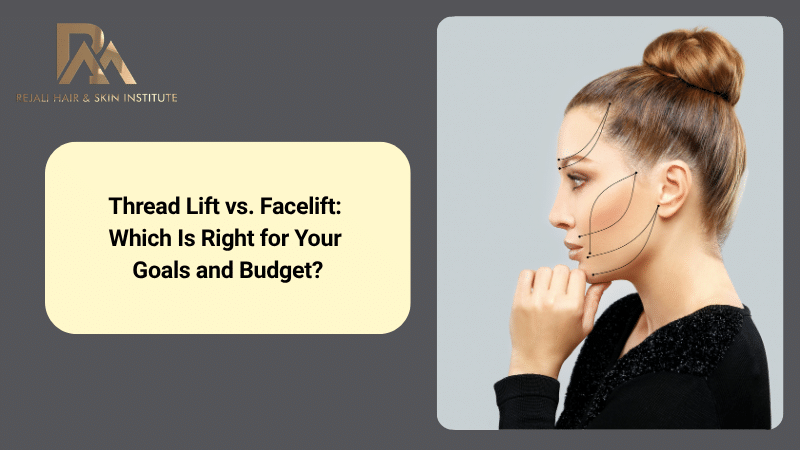
The simplest way to frame thread lift vs. facelift is this: a thread lift is a subtle, low-downtime refresh for mild-to-moderate sagging, while a facelift is a more invasive surgical procedure built to address significant laxity with dramatically longer-lasting results. Neither is universally “better” — they’re built for different stages of facial aging, and choosing between them mostly comes down to how much correction you actually need.
How Each Procedure Works
A thread lift uses fine, dissolvable sutures inserted beneath the skin with a thin needle to mechanically pull sagging tissue upward, while also stimulating collagen production as the threads dissolve over several months. It’s done under local anesthesia in about an hour, with patients typically able to drive themselves home and return to normal activity almost immediately.
A facelift is a surgical procedure performed under general or heavier sedation, involving incisions, tissue repositioning, and the removal of excess skin. It requires a more significant recovery period measured in weeks, not days, but it can correct a degree of sagging that threads simply aren’t designed to address.
Comparing Results and Longevity
This is where the two options diverge most. Thread lift results tend to last one to three years, since the effect depends partly on the threads’ temporary physical lift and partly on the collagen response they trigger as they dissolve. A facelift’s results, by contrast, can last up to a decade, because it physically repositions and removes tissue rather than relying on a temporary scaffold.
Thread lifts also produce a more subtle change — typically lifting the face by only a few millimeters — which many patients prefer because it reads as a natural refresh rather than an obviously “done” result. A facelift can deliver a more dramatic correction, which matters more for patients with significant sagging than for those catching early changes.
Downtime and Recovery
A thread lift involves minimal downtime: mild soreness or swelling is common, but most patients return to work the same day and avoid only vigorous face rubbing and jaw movement for about a week. A facelift requires a real recovery period, with swelling and bruising that can take weeks to resolve and activity restrictions that last longer than almost any non-surgical option on the market.
Cost Considerations
Thread lifts are generally the lower-cost option upfront, priced by the number of threads and areas treated. A facelift represents a larger investment reflecting the surgical facility, anesthesia, and surgeon time involved — but because its results last so much longer, the cost-per-year of results can look different than the sticker price alone suggests. For patients weighing a thread lift against other non-surgical options, our page on PDO thread lifts covers pricing considerations and what’s included in a typical treatment.
Who Tends to Choose Each Option
Patients in their late 30s to early 50s with mild to moderate skin laxity, who want a natural refresh without surgery or extended downtime, are typically the best fit for a thread lift. Patients with more significant sagging, looser skin, or who want a longer-lasting correction tend to be better served by a surgical facelift, even with the longer recovery involved. Some patients also use a thread lift as a way to address early signs of aging — like drooping brows — before committing to surgery down the road, a use case our page on thread lifts for drooping eyebrows explains in more detail.
Key Takeaways
- Thread lifts suit mild-to-moderate sagging; facelifts are built for more significant correction.
- Thread lift results last one to three years; facelift results can last up to a decade.
- Thread lifts involve local anesthesia and days of recovery; facelifts involve a surgical recovery measured in weeks.
- The right choice depends on how much correction you need, not which option is less invasive on paper.
FAQ
Can a thread lift be done before eventually getting a facelift? Yes — some patients use a thread lift to address early sagging and delay surgery, switching to a facelift later if their goals or laxity change.
Is a thread lift as effective as a facelift? For significant sagging, no — but for mild-to-moderate laxity, many patients find a thread lift delivers a satisfying, natural-looking result without surgery.
Which option has a faster recovery? A thread lift, by a wide margin — most patients resume normal activity within a day or two, compared to weeks for a facelift.
To figure out which option actually fits your face and goals, schedule a free consultation with Dr. Rejali Hair & Skin Institute.