










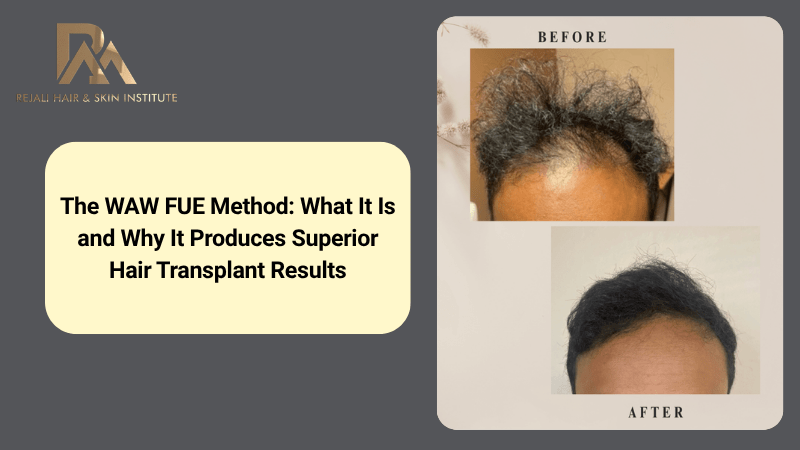
If you’ve been researching hair restoration, you’ve likely come across the WAW FUE method mentioned as one of the more advanced tools in modern hair transplant surgery. It’s not a marketing buzzword — it’s a specific piece of technology built around a single goal: getting more of your transplanted follicles to survive. Understanding how it works can help you ask better questions at your next consultation, whether or not the clinic you’re considering actually uses it.
What the WAW FUE Method Actually Is
WAW FUE is a follicular unit extraction system built around a hybrid “trumpet” (sometimes called tornado) punch — a two-layer tool with a sharp, square outer edge paired with a smooth, funnel-shaped inner edge. The outer edge scores the skin, while the inner edge guides the follicle out along its natural curve instead of forcing a straight path through it. Because so many follicles grow at a slight angle or curve beneath the scalp, that distinction matters more than it might sound.
The handpiece itself is wireless and controlled through a connected app, letting the surgeon fine-tune speed, rotation, oscillation, and punch angle in real time as the extraction moves across the donor area. Punch diameters typically run around 0.8–0.9 mm, small enough to leave extraction points that heal quickly and blend into the surrounding hair.
Why the Punch Design Changes the Outcome
The practical reason surgeons adopt this system comes down to transection — the accidental severing of a follicle during extraction. A transected graft can’t grow hair, and because donor supply is finite and non-renewable, every transected follicle is one you can’t get back. Worldwide, average transection rates with older or lower-quality punches can run as high as 20–30%, while a well-executed procedure using a hybrid punch system is commonly associated with rates under 4%.
That difference shows up in the grafts themselves. Surgeons using this method often describe the extracted follicular units as fuller and more intact, with more surrounding tissue preserved — which supports faster, more reliable regrowth once they’re implanted. Smaller, cleaner extraction sites also tend to mean less visible trauma to the donor area and a quicker return to normal activity.
How This Fits Into a Full FUE Procedure
The punch and handpiece are only one part of the process — extraction still has to be paired with careful graft handling, correctly sized recipient sites, and a hairline design that matches your face and hair. Our page on the role hybrid punches play in modern hair transplants goes deeper into how these tools compare to older sharp and blunt punch designs across different clinics.
At Dr. Rejali Hair & Skin Institute, Dr. Farhad Rejali performs every stage of the FUE procedure himself rather than delegating extraction or placement to technicians — a distinction we cover in more detail on our page about why Dr. Rejali personally performs every step of your FUE procedure. Technology can reduce the margin for error, but it doesn’t replace the judgment involved in reading each follicle’s angle and adjusting technique accordingly.
Is the WAW FUE Method Right for Every Patient?
Not every case calls for the same approach. Curly or tightly coiled hair, scarred donor tissue, or a patient who’s had a prior transplant can all change how a punch performs, which is why a hands-on assessment matters more than any single tool’s specifications. What the WAW system does reliably provide is a lower-trauma way to extract grafts across a wide range of hair types, which is part of why it’s become a standard option among surgeons focused on graft preservation.
Key Takeaways
- The WAW FUE method uses a hybrid trumpet-shaped punch that follows the follicle’s natural curve instead of cutting straight through it.
- Its wireless, app-controlled handpiece lets a surgeon adjust speed, angle, and rotation during extraction.
- Reduced transection rates (often under 4%) mean more of your limited donor supply survives to be transplanted.
- The technology supports the result — but surgeon skill and hairline design still determine how natural the outcome looks.
FAQ
Is WAW FUE the same as regular FUE? No. Standard FUE can use a variety of punch types, including simple sharp or blunt punches. WAW FUE specifically refers to the hybrid trumpet-punch system designed to reduce follicle transection during extraction.
Does the WAW FUE method hurt more or less than traditional FUE? Most patients report a similar experience during the procedure itself, since both use local anesthesia. The smaller, more precise extraction sites associated with hybrid punches are generally linked to less post-procedure discomfort and faster surface healing.
Can the WAW FUE method be used for curly or coarse hair? Yes, though technique adjustments and real-time testing are often needed, since curved follicles are more prone to transection with any extraction method.
If you’d like to find out whether this approach fits your hair type and goals, you can schedule a free consultation with Dr. Rejali Hair & Skin Institute in Scottsdale.