










Choosing a hair transplant surgeon is the decision that shapes your result more than any technique, tool, or price. The best way to find a trustworthy one is to check three things: verifiable credentials, documented results for patients like you, and a clear answer about who performs each step of the surgery. Here’s the checklist Dr. Rejali’s office recommends to patients, whether or not they end up choosing our practice.
What Credentials Should a Hair Transplant Surgeon Have?
Start with the basics you can check yourself. Your surgeon should hold an active medical license in your state, with no unresolved disciplinary actions. Your state’s licensing board website lets you look this up in a few minutes. Beyond licensing, look for specialized training in hair restoration.
The American Board of Hair Restoration Surgery is the certifying board focused specifically on hair restoration surgery. Diplomates must pass written and oral exams and agree to the board’s code of ethics, and the board keeps a directory you can search. Dr. Rejali has been a member of the ABHRS since 2010.
Who Actually Performs the Surgery?
Ask directly: who designs the hairline, who extracts the grafts, and who creates the recipient sites? These three steps determine how natural your result looks and how many grafts survive. At some high-volume clinics, technicians perform most of the surgery while the doctor supervises several cases at once. At our office, Dr. Rejali personally performs all of these critical steps. Our article on why FUE should be done only by certified doctors explains why this matters.
How Do I Evaluate Before-and-After Results?
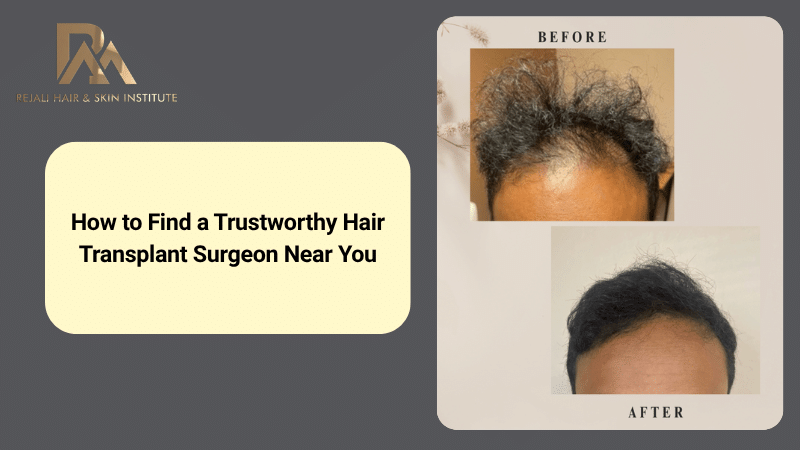
Look for consistency, not just a few great photos. A trustworthy surgeon should be able to show:
- Results for patients with hair loss and hair type similar to yours
- Photos taken in similar lighting and angles, before and after
- Results at a realistic time point, ideally 9 to 12 months
- Graft counts and Norwood stage for each case, when available
Our hair gallery and patient stories show real cases with timelines.
What Are the Red Flags During a Consultation?
Walk away, or at least get another opinion, if you see:
| Red flag | Why it’s a problem |
|---|---|
| Pressure to book the same day | Good surgeons don’t need deadlines to win patients |
| Promises of full density in one session | Results depend on donor supply and loss pattern |
| No exam of the donor area | Graft estimates without an exam are guesses |
| Vague answers about who does the surgery | Technician-led surgery is a common cause of poor results |
| Prices far below the market | Usually reflects shortcuts in time, staff, or technique |
What Questions Should I Ask?
Bring a list. These questions tend to reveal the most:
- How long have you been performing hair restoration surgery?
- Which steps of my procedure will you personally perform?
- How many grafts do I realistically need, and how many can my donor area support over time?
- Do you recommend FUE, FUT, or another approach for me, and why?
- How do you plan for hair loss that may continue after surgery?
- Can I see results for patients with hair like mine?
Does Experience With Difficult Cases Matter?
Yes, even if your case seems simple. Surgeons who handle complex work, such as revisions, scar tissue, or tightly curled hair, have to master graft handling and planning. Dr. Rejali has practiced hair restoration since 2006, performed thousands of FUT procedures before shifting his primary focus to ultra-refined FUE, and regularly takes on cases other clinics decline, including correcting unsuccessful earlier transplants.
Why Choose a Local Surgeon?
Your follow-up care matters. Seeing a surgeon near you makes it easier to attend post-op visits, ask questions during healing, and plan future sessions if needed. For patients in Scottsdale and the greater Phoenix area, a local surgeon also means you can meet in person, see the office, and judge the team before committing.
Key Takeaways
- Verify your surgeon’s license and look for specialized hair restoration training, such as ABHRS membership.
- Ask exactly who performs hairline design, extraction, and recipient site creation.
- Judge results by consistency across many cases similar to yours.
- Same-day pressure, guaranteed density, and unusually low prices are red flags.
FAQ
Is a dermatologist or plastic surgeon better for a hair transplant? Specialty matters less than focused hair restoration experience. Look for a physician who performs hair transplants regularly and can show consistent results.
How many consultations should I have? Many patients meet with two or three surgeons. Comparing plans, not just prices, makes it easier to spot the best fit.
Can I check if a surgeon is ABHRS certified? Yes. The ABHRS website has a physician directory you can search.
What if a clinic won’t tell me who performs the surgery? Treat it as a warning sign. A trustworthy practice will answer clearly.
Ready to meet a surgeon who’ll answer every question directly? Schedule a free consultation with Dr. Rejali Hair & Skin Institute in Scottsdale.