










How to Get a Natural-Looking Hair Transplant: What Sets the Best Results Apart
A natural-looking hair transplant is built through diagnosis, restraint, and careful execution — not simply by moving as many grafts as possible.
Key Takeaways
- Confirm the cause and pattern of hair loss before planning surgery.
- Design an age-appropriate hairline that suits your face and hair characteristics.
- Preserve the donor area so it remains useful if thinning continues.
- Choose technique and graft placement based on your anatomy, not marketing language.
- Give the transplanted hair enough time to mature before judging the result.
Start with an accurate diagnosis and realistic goals
“How many grafts will I need?” is often the first question patients ask. The better starting question is what is causing the hair loss, how stable it is, and what the donor area can realistically support. Pattern loss is common but not the only explanation for thinning — family history, sudden shedding, scalp inflammation, and medications all factor in, and surgery shouldn’t cover an unexplained or actively changing condition without addressing the diagnosis first. (This hair transplant surgery guide covers how donor follicles are selected, prepared, and moved.)
Donor density, caliber, curl, and color contrast all affect how many grafts a given goal actually requires — someone with modest loss and strong donor characteristics may need far fewer grafts than someone with widespread thinning, even with similar goals. Planning also has to account for future Norwood progression: a hairline that looks dense today can look isolated if the hair behind it keeps receding, so a conservative first procedure often produces a more convincing long-term result than spending the entire donor supply at once. At Dr. Rejali Hair & Skin Institute, a consultation starts with these variables rather than a fixed promise before the scalp has been assessed — including what maintenance existing hair may still need alongside surgery.
Design a hairline that fits your face
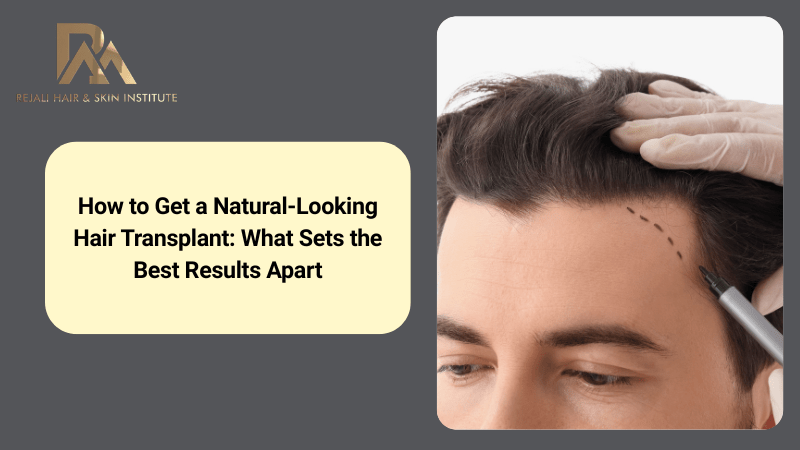
A hairline isn’t a ruler-straight border set at the lowest point on the forehead — it frames the face and has to work with the patient’s age, facial proportions, and native hair. A younger face may tolerate a slightly lower line, but older patients — especially with limited donor supply — often benefit from a more mature design with measured recession. Hair caliber, color, curl, and hair-to-skin contrast all influence how much coverage is actually needed.
Natural hairlines also carry small, subtle irregularities in height, spacing, and direction rather than perfect symmetry; that micro-variation at the front edge is what keeps a design from reading as drawn-on. (Our piece on natural hairline design goes deeper into that artistic judgment.) The surgeon should mark the proposed shape with you seated and standing, since facial balance shifts by angle, and the design should leave room for native hair to keep thinning behind it — using too many grafts up front can leave too little donor hair for later.
Preserve and use the donor area strategically
The donor area — hair at the back and sides less affected by pattern loss — is a finite resource, and overharvesting can create visible thinning there, particularly with short hairstyles. A proper assessment looks at density across the zone, hair caliber, and follicular-unit composition (a graft may carry one, two, three, or more hairs), since these details drive both how many grafts are needed and how much can be taken without depleting the area. Extraction should be distributed rather than concentrated, and patients who prefer short cuts should ask specifically how the donor zone will look at different lengths. Beard or body hair can supplement scalp donor supply when it’s limited, but the texture and growth cycle differ enough that it’s better suited to selected areas than a visible frontal edge.
These questions help rank priorities when donor supply and current goals are in tension:
- Which area changes the appearance most when restored?
- How much donor hair should stay reserved for future loss?
- What density is realistic for the first procedure?
- What’s the plan if native hair behind the transplant thins?
Choose technique and place grafts with natural growth patterns
FUE and FUT are just two ways of harvesting grafts — neither guarantees a natural result on its own. FUE removes individual follicular units, leaving small scattered extraction points; FUT removes a strip of tissue, creating a linear scar but often yielding more grafts per session. The right choice depends on donor characteristics, graft numbers needed, hairstyle preferences, and prior procedures — and once grafts are removed, gentle handling, proper hydration, and prompt placement matter as much as the harvesting method for whether they survive.
Placement is where the result actually becomes natural or artificial. Hair doesn’t exit the scalp at one uniform angle — it lies flatter at the temples and angles differently at the crown — so the surgeon needs to study the patient’s existing pattern rather than impose a repeated one. Single-hair grafts belong at the delicate front edge, with multi-hair grafts adding density farther back where the eye expects more volume; density should build gradually rather than jump from sparse to packed. Curl, texture, and the direction hair bends as it exits the skin all need to match the surrounding native hair for the transplanted area to merge rather than read as a separate patch. Some patients are also better served by a staged approach — treating one priority area first, seeing how it matures, and addressing the rest later — rather than a single combined session.
Choose a qualified surgeon and well-run clinic
A polished website or a low price can’t tell you whether the person performing the key steps — hairline design, extraction, implantation — has the training and judgment to do it well. Confirm the physician’s license, hair-restoration-specific training, and experience relevant to your pattern of loss; Dr. Farhad Rejali has practiced hair restoration since 2006 and has been a member of the American Board of Hair Restoration Surgery since 2010. Ask directly who examines you, draws the hairline, and performs each surgical step — a physician-led plan shouldn’t be confused with a brief physician appearance followed by an unnamed team doing the substantive work. (Our doctor selection guide and before-and-after review guide cover how to vet credentials and photo galleries in more depth — look for consistent lighting, angles, and timing, and be cautious of images that conceal the hairline or use heavy styling.) A serious consultation should also cover medical history, infection control, and what happens if healing doesn’t follow the expected course; if that sounds right for you, you can request a consultation.
Support healing and evaluate the result over time
Surgery ends on the day of implantation, but the result develops over many months. Transplanted hairs often shed after placement while the follicles remain beneath the skin — unsettling, but usually part of the expected cycle — and visible regrowth develops gradually, continuing to thicken well past the first sprouts. Follow the clinic’s instructions on washing, sleeping position, and sun exposure during early healing, and contact them promptly (not a forum) if you notice worsening pain, spreading redness, significant drainage, or fever.
Existing native hair can keep thinning during this period, which is why some patients also need an ongoing medical treatment plan alongside the transplant — that’s not a sign the procedure failed. Judge the final result only after full maturation: many patients need roughly twelve months or more, particularly when the crown is involved, so comparing early photos against someone else’s further-along result mostly just creates unnecessary anxiety.
Don’t settle for less than you deserve.
A natural-looking hair transplant comes from a sound diagnosis, a conservative hairline, disciplined donor management, careful graft placement, and a surgeon who stays involved from planning through follow-up. The best result isn’t necessarily the densest or most dramatic one — it’s the one that fits your face today and still makes sense as your hair changes.
Frequently Asked Questions
Will a hair transplant look completely natural? It can, when diagnosis, hairline design, graft selection, angles, density, and aftercare are all handled carefully. Results vary by donor characteristics, hair loss pattern, surgical skill, and healing.
How do I know whether I am a good candidate? A clinician needs to assess the cause and stability of your hair loss, your donor area quality, and whether the recipient scalp can support growth — a consultation is required to determine candidacy.
Is FUE better than FUT for a natural result? Neither is automatically better for everyone. They differ in harvesting method, scarring, and donor management; the right choice depends on your goals and anatomy.
How many grafts will I need? That depends on the area being restored, degree of loss, hair caliber, donor density, and your long-term plan — a graft number should come from an examination, not a generic package.
Can hair loss continue after a transplant? Yes. Transplanted follicles may remain stable while nearby native hair keeps thinning, which is why a clinician may recommend medical treatment or monitoring alongside surgery.
What makes a transplanted hairline look artificial? Common causes include a line that’s too low or too straight, excessive symmetry, incorrect growth angles, multi-hair grafts at the front edge, abrupt density changes, and overharvesting of the donor area.